



Neema “Academic Agent” Parvini recently published an article titled It’s Only ‘Demoralising’ If You Can’t Accept the Truth
For years, Parvini has promoted falsehoods about political reality with appeals to what he calls “elite theory”, culminating in this screed of demoralisation and blackpilling.
Now, there are certainly some useful insights in the classical elite theorists — Mosca, Pareto and Michels — concerning the oligarchic tendencies of political organisation and the durability of ruling elites — though, to most anyone who has thought seriously about political change, these are mostly rather banal. But Parvini and his band of haughty disciples, who have arrogated to themselves the mantle of “elite theorists”, have twisted these observations into supposedly universal laws, from which they claim to deduce the impossibility of meaningful political change, while looking down their noses at the lesser-minds foolish enough to actually engage in politics (as, for example, when they insisted Rupert Lowe’s Restore Britain was a “containment op” on the basis of some flimsy connections to Zionism).
For a perfect demonstration of what I’m talking about, consider that in this article Parvini invokes an “Iron Law of Oligarchy” to make this sweeping claim:
Given these facts, we can conclude that there is no political solution. You can’t change the system from within (because the system will change you, a.k.a. the Iron Law of Oligarchy), and you can’t change it from without (because the system will obliterate you).
This is an extraordinary leap of logic. That political organisations tend towards oligarchy, and that their leaders face powerful incentives to preserve their own positions, does not establish that those leaders must invariably be co-opted by the existing political order. How could such a universal claim even be demonstrated?
As for its source, Michels formulated the iron law of oligarchy to argue that political organisations inevitably develop oligarchic leadership structures. In his 1911 book Political Parties, he wrote that “Organization implies the tendency to oligarchy” and:
As a result of organization, every party or professional union becomes divided into a minority of directors and a majority of directed.
This is obviously a world away from the sweeping universal claim Parvini is making. That political movements inevitably develop oligarchic leadership structures, and that their leaders acquire interests which may diverge from those of their followers, is a useful enough observation, if not the profound revelation Parvini and other elite theory gurus seem to think it is. It certainly does not establish that the minority leadership will therefore acquiesce to the system, sell their followers out, or drop any idealism on contact with power. Nor could such a claim ever be demonstrated. Indeed, a revolutionary movement could completely overthrow an established ruling elite, install its own oligarchy and thereby vindicate Michels’s theory without vindicating Parvini’s conclusions in the slightest.
The inevitability of oligarchy, even if we grant it, does not entail the permanence of any particular oligarchy. Parvini has simply confused the two, which seems like an astonishingly elementary error for someone who wrote two books on elite theory.
The problem with bad theory in politics is the bad predictions it leads one to make, and the bad action it inevitably leads one to prescribe. This article is full of bad advice. Parvini’s prediction is that change is impossible, and his counsel is to give up and focus on lower cortisol activities like talking and writing about politics for a living.
Parvini’s first mistake is to treat “the system” or “power” as though it were a single, unified organism, possessed of an unchanging will and an infinite capacity for self-preservation. He first points to the enormous coercive resources of modern Western states, as though the existence of these institutions guarantees the permanence of the political order that currently commands them:
The combined workforce of the Five Eyes intelligence agencies is somewhere in the region of 200,000 personnel. NATO stands around 3.65 million active military personnel. In addition, there are around 2.25 million police officers.
Well it’s a good thing none of the populist movements in the West are planning on defeating NATO in a ground war, then. He also dismisses King’s College professor David Betz’s predictions of civil conflict arising from multiculturalism as “absurd” and “hyperbolic”, without offering any further argument.
Parvini’s examples are illustrative, though for the opposite reasons he employs them. For example, in discussing recent unrest in France, he writes:
The current riots are smaller than the Pension Protests of 2023, the Yellow Vests of 2018, and vastly smaller than the May 1968 riots and general strike — none of which changed the power structure in France.
This omits the rather inconvenient detail that the vision of “the 68’ers” has become the orthodoxy of contemporary France. The ideology of the student radicals has won to the point of complete cultural hegemony, and the Baby Boomers in those protests successfully replaced the older, more patriotic and conservative French establishment they challenged. That their actual protests did not lead to an immediate collapse of the French state is irrelevant, and wasn’t their purpose to begin with. In fact, even saying the protests themselves achieved no major concessions is inaccurate, as the government was forced into the Grenelle negotiations, which resulted in a 35% increase in the minimum wage, general wage increases and expanded trade union rights, as well as major reforms to the French university system.
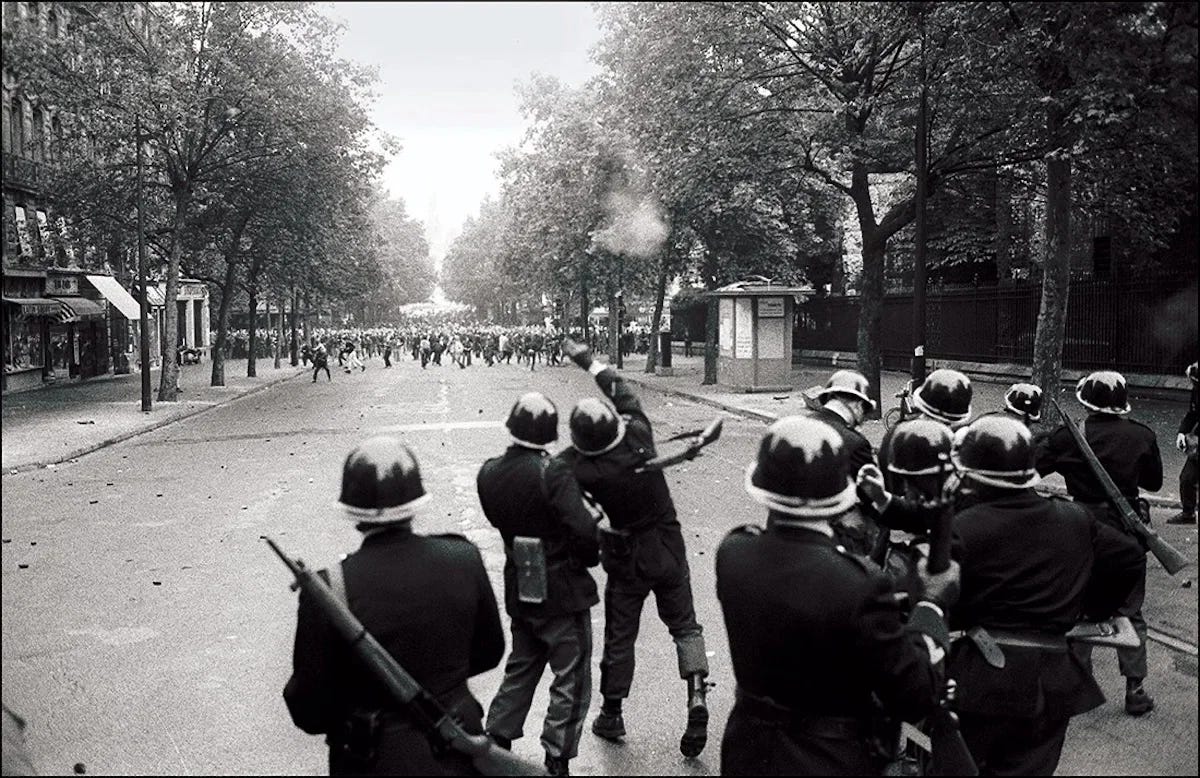
But these concessions pale in comparison to the longer-term, cultural changes the 68’ers effected. The Gaullists actually won a landslide in the election that followed that year, but the longer-term cultural and institutional consequences of the upheaval were profound. French attitudes on everything from education to race and sexuality have been moulded to conform to the vision of the 68’ers as the Boomer radicals entered culture-making institutions. Rightists who recognise how radical the 60s cultural revolution was should be the first to recognise the significance of this kind of metapolitical victory, but Parvini’s criterion of success would have us dismiss this as a failure because de Gaulle remained in power.
Similar comments can be made about the Civil Rights Movement, which Parvini lists among a collection of radical movements that were “systematically contained, co-opted, infiltrated and then man-managed by the security state.”
In 2026, it certainly looks like the Civil Rights Movement won. Civil Rights Law has achieved such prominence in the American legal system that it not only succeeded in dismantling the institutional foundations of segregation, but is now effectively a second constitution — most of the leaders of the movement couldn’t have imagined winning this hard.
Obviously, the fact that a movement was partially co-opted does not mean that it failed to transform the institutions that absorbed it. Indeed, if you’re a genuine “realist” about political change then the capacity of a movement to have its principles incorporated into the governing assumptions of the establishment has to be considered one of the most consequential forms of political success.
Of course, Parvini could respond that these movements only succeeded because they enjoyed the support of powerful factions within the existing establishment. But this only concedes the point that political change is possible through the realignment of and replacement of elites. At one time, the American elite did not support total racial egalitarianism, and the French elite did not support free love and open borders; over time, thanks to the cultural victories of leftism and structural changes in the composition of the elite, people that shared these convictions came to dominate elite opinion. Nothing dictates that the same kind of change cannot happen in another direction.
It may well be that the contemporary dissident right is destined to fall short of the resources, manpower, institutional allies or favourable circumstances that made these earlier movements successful. That would be a perfectly reasonable argument to make, and one that could be assessed on its merits. But there is nothing to discuss when someone claims privileged access to universal laws of political power that make meaningful change impossible — a rank absurdity on its face.
I could provide plenty of counterexamples to Parvini’s fatalism, but it’s basically futile in his case, since he has constructed an unfalsifiable and circular series of assumptions which he can use to reframe any historical example as further proof of his system. If an outsider movement succeeded in its goals, it’s because “power” eventually deemed it useful. If it failed, or only partially succeeded, it’s further proof of the iron law of oligarchy. Somehow, despite no system ever crumbling to outside forces internally, living Germans have lived under monarchism, liberal democracy, National Socialism, communism and multiculturalism in one lifetime. Political orders rose and fell, entire ruling classes lost legitimacy and were displaced, and seemingly indestructible institutions disappeared overnight. Yet none of this contradicts the supposed permanence of political power. Because power dictated it, you see!
The problem with Parvini’s counsel of despair is not just the bad theory of political change that informs it — he also presents a false choice between fundamentally overturning the political order and withdrawing from politics altogether. But between the complete conquest of state power and political resignation lies an enormous range of possibilities. Even if one accepted that demographic change is unlikely to be reversed by a democratic revolution, there will still be millions of increasingly racially conscious White people living in multicultural states, with interests and concerns that may not be adequately represented by the political establishment. Organised racial groups have had enormous power to lobby and network in their interests as minorities — Jews being the most obvious example of power and success relative to their perpetual minority status. Parvini is not only telling people a revolution or democratic takeover of the state is unlikely, which is perhaps defensible — he is telling them that this means they should do nothing and return to the blissful thoughtlessness of individualism.
Sadly, this fatalism is self-fulfilling. While other groups lobby and agitate for any extra rights, recognition and power available to them with the political means at their disposal, many on the right will listen to men like Parvini who tell them to resign and allow every other group to freely contest the playing field. There is no guarantee of victory, and no reason to indulge the comforting fantasies of those who insist it’s just around the corner. But the appropriate response to political disappointment is a more sober assessment of what can be achieved, and a roadmap to achieving it.
Power is not an abstract, omniscient entity capable of controlling all its challengers; it is continually contested by competing interests and won by those best able to organise, manoeuvre and exploit the larger historical forces of their age. I don’t know how much of it can be gained in my lifetime; I do know our enemies — who hold people like Neema and me in murderous contempt — will carry on pursuing it relentlessly, and there is something particularly absurd about self-proclaimed experts on power advising us to hand it to them.
Thanks for reading. I can no longer accept paid subscriptions on Substack, having lost access to Stripe and most other payment processors after being placed on a financial blacklist in a particularly egregious case of ideological censorship.
If you would like to support my independent work, please consider making a cryptocurrency donation using one of the addresses below, or contact me directly to arrange an alternative donation method.
Had to mute AA on X over a year ago, now, as his constant pessimism and counter-signaling of his supposed allies was exceedingly irritating.
This particular formulation of elite theory as a "Black Lotus card to win any argument" seems to attract a certain type of personality. The spiteful, resentful and vulnerable narcissist kind.