

After a recent rewatch of Michael Mann’s Heat, I concluded it must be one of the greatest films ever made.
This led to me taking a greater interest in some of Mann’s less acclaimed works, finally viewing his 2006 Miami Vice. As it happened, I watched this film almost to the day of the 20th anniversary of its release, which gave me extra pause for reflection on a movie that now seems like one of the greatest time capsules of the early 2000s.

I should make it clear: Miami Vice is nowhere near Mann’s best film. The film never really develops emotional stakes and we’re not given much to explore beneath the brooding central characters; much of the early dialogue and plot borders on unintelligible. Once the story does become clear, it turns out to be fairly conventional Hollywood territory: two undercover police officers infiltrate a drug cartel, become entangled with criminals, and watch their operation go wrong.
The reception was especially frosty because Mann basically disappointed everyone expecting a summer blockbuster action flick by delivering a two-hour experimental mood piece. On top of that, it was a reboot of a beloved television franchise that presented a much glitzier, more romantic picture of Miami. And yet, the film has undergone a reappraisal in recent years and now enjoys a small cult following, and a fortnight after viewing it I am still thinking of the mood Mann captured. So what is it that’s captivating?
Firstly, Miami Vice is saturated with 2006. Mann intentionally broke with audience expectations of a nostalgic reboot of the 1980s television show and tried to make something blisteringly modern. In 2006, that looked like speedboats, BlackBerrys and flip phones, glass towers, nightclubs, and surveillance technology.

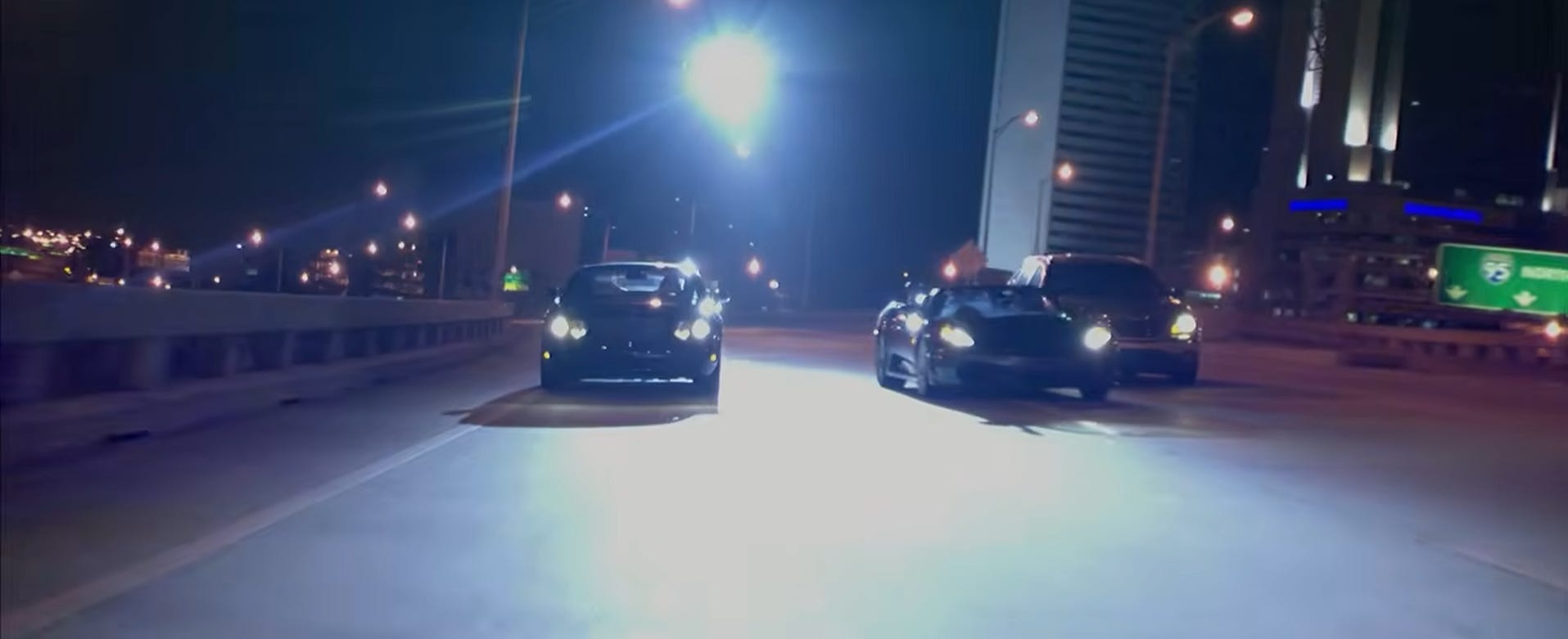
The technology serves another function: it makes you feel like you’re dropped in a world of globalised movement. Characters move between cities seamlessly by air and sea, and Miami itself feels like a node connecting America, Latin America and the Caribbean.
Then there is Mann’s use of digital cinematography. Miami Vice is shot overwhelmingly with HD digital cameras. In 2006, this was still unusual. Most major Hollywood films were shot on 35mm, while digital was often used only in parts or made to look like film.
Where conventional cinematography often isolates a subject by throwing the background out of focus, Mann deliberately exploited the enormous depth of field offered by his HD cameras. He pushed his digital cameras to their technical limits in low-light conditions, which has the effect of producing a kind of digital noise in the background of scenes. The characters are never really separated cleanly from the world around them, meaning the colours and texture of environment communicates far more of the mood than it does in other films.
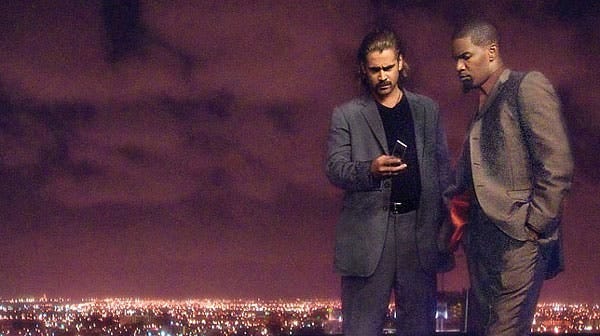

The environment itself is in constant movement, giving the film a persistent sense of instability: a world of speed, unstable identities and technological mediation. Beneath the digital haze is a theme that recurs throughout Mann’s work — the contrast between the extraordinary order of technological modernity and the isolation of the individual within it. Heat is built around the same tension.
Mann’s films show highly organised infrastructure networks and technical efficiency. Los Angeles and Miami both present the cutting edge of modernity. The characters in Heat and Miami Vice are highly specialised in their fields, but also lonely and alienated. In Heat, Neil McCauley’s rule that he must be willing to walk away from anything in thirty seconds reflects his own professional mastery and a philosophy of absolute rootlessness.
What’s interesting about Mann, though, is that he does not present this world as cruel or ugly to make this point. He finds immense beauty in this contrast.
The right tends to look for beauty in conventional sources and styles. Yet depictions of modern or futuristic urban settings like Blade Runner and Drive have been a great source of aesthetic inspiration for the new right. At first glance this seems counter-intuitive. Technology and urban development are typically ugly impositions on natural beauty. Modern cities, especially, are overwhelmingly composed of instrumental structures: roads, office towers, car parks, airports, power lines, warehouses and anonymous apartment blocks. All of these exist as a means to other ends, and none are primarily designed to be beautiful.
But there is nothing contradictory about this also being beautiful. A Platonic conception of beauty sees it as a recognition of order and proportion; beauty reminds us of the underlying intelligibility of reality. Iris Murdoch, working in a Platonic tradition, described the experience of beauty as a form of ‘unselfing’, an experience that draws us out of our own ego and directs attention toward something real and independent of us. Mann makes urban environments beautiful by taking in their full scale and giving a rhythm and order to technological functioning that makes the individual feel insignificant. That insignificance is alienating, but it is also beautiful in its unselfing. An airport runway at night, a bridge, or a city skyline can confront us with a world that far exceeds our private concerns. The experience is alienating, but there is something strangely liberating in having our own concerns reduced to their proper scale.
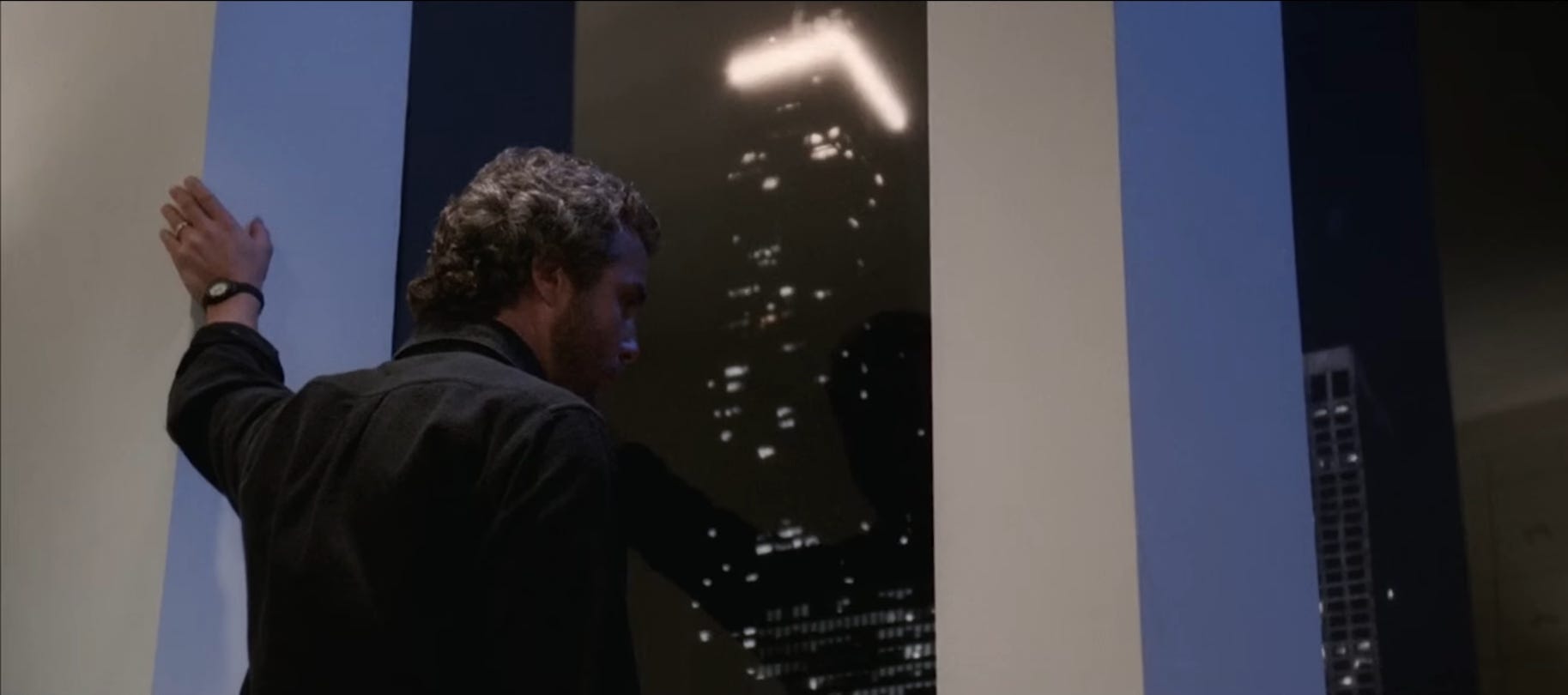
Mann’s films often give the very impersonality of instrumental order an aesthetic grandeur. Something as simple as a lit runway, the setting of Heat’s climactic scene, can become beautiful using exactly what makes it impersonal and alienating. At a glance, we see immense scale and technical coordination, the rhythmic order of airline traffic carrying innumerable other personal stories, and the drama of McCauley and Hanna illuminated by the purely functional artificial lights of the runway.
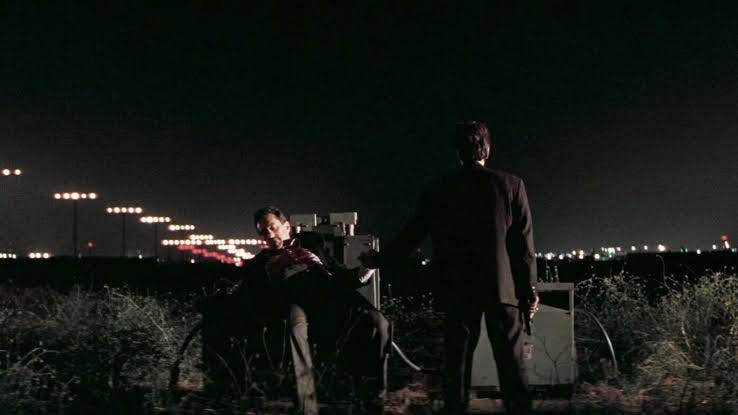
At their best, Mann’s films approach a kind of technological sublime.
Roger Scruton described the sublime as a “vista which invites another kind of judgment, in which we measure ourselves against the awesome infinity of the world, and become conscious of our finitude and frailty.”

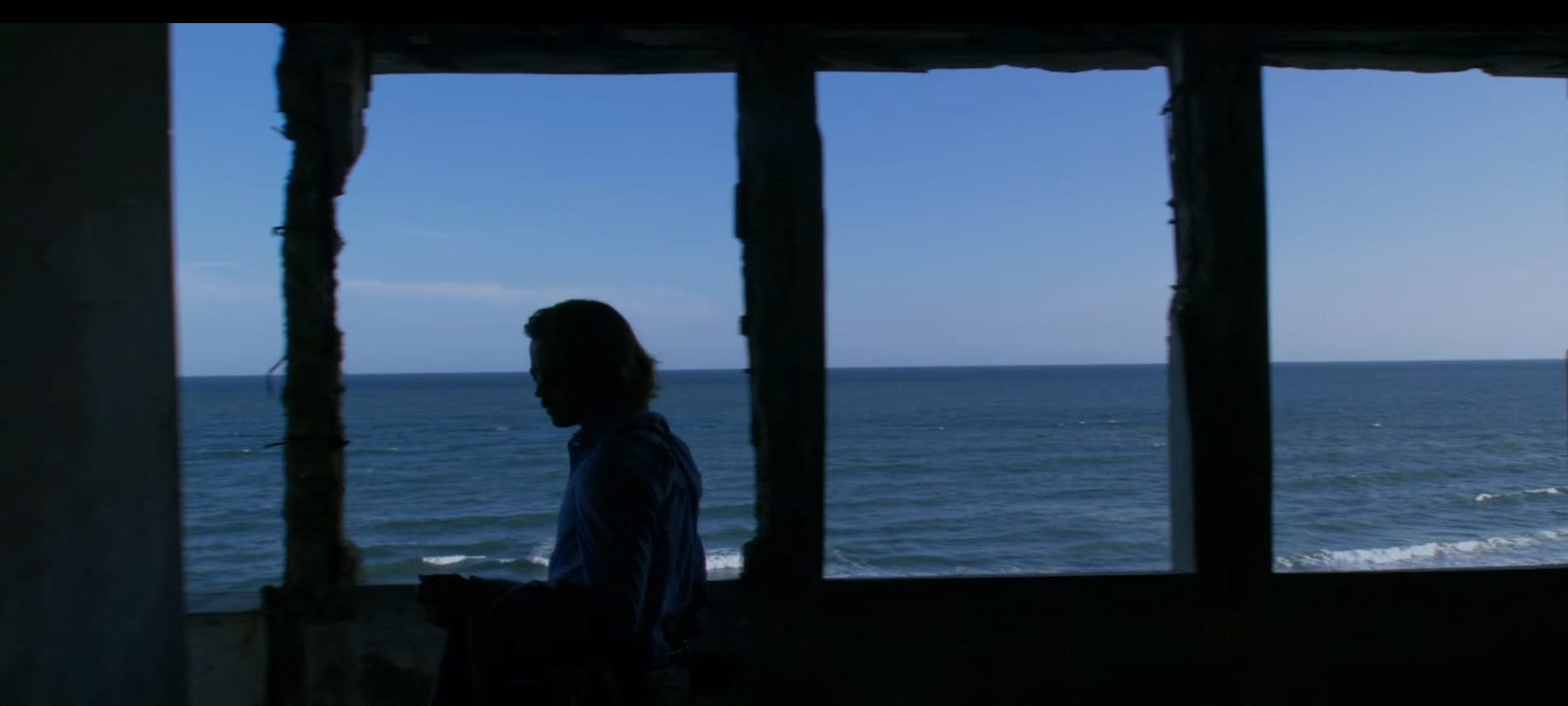
The traditional sublime emerges from confronting something so vast or powerful that the individual feels diminished before it. Edmund Burke described this as something like an overwhelming sense of impersonal power, using examples like dark forests, dangerous animals, and most clearly of all, the ocean: “the ocean is an object of no small terror. Indeed terror is in all cases whatsoever, either more openly or latently, the ruling principle of the sublime.”
Interestingly, many of the most iconic shots from Mann’s films feature characters brooding over the ocean.

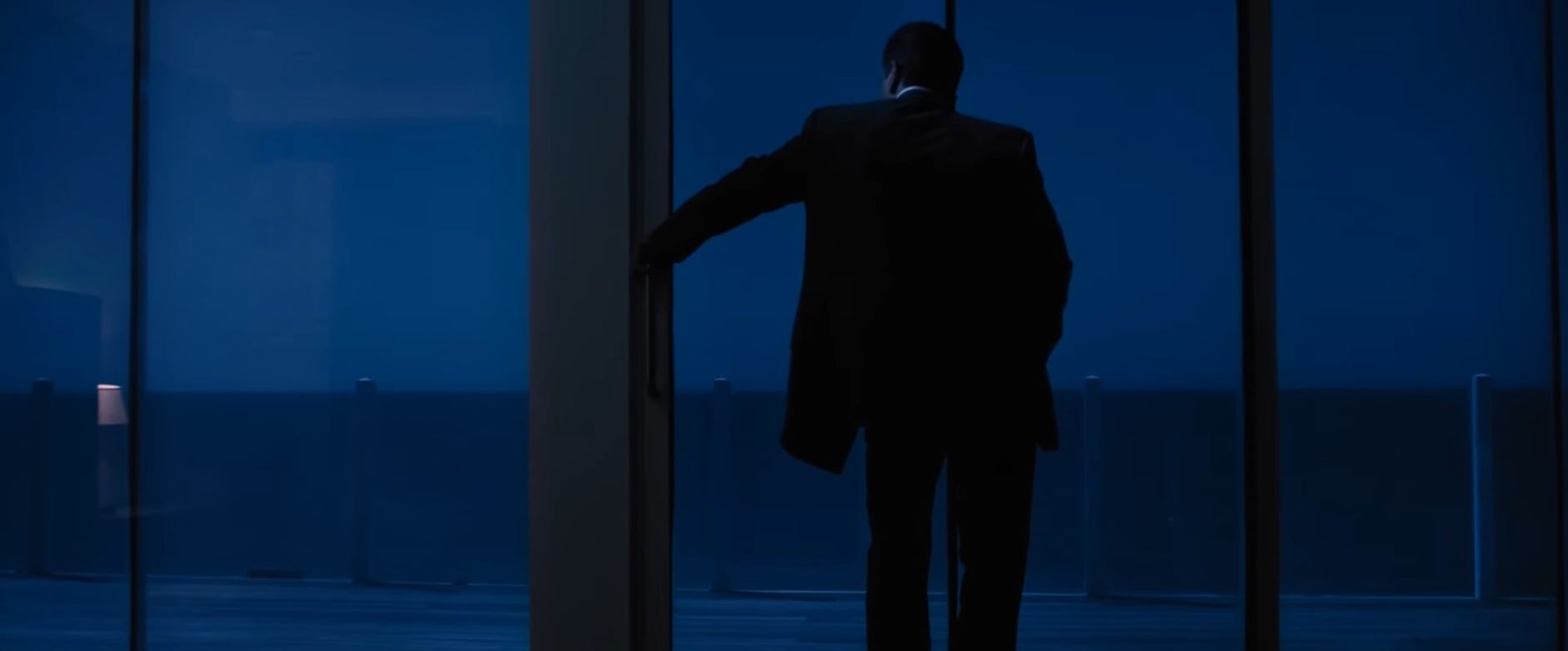
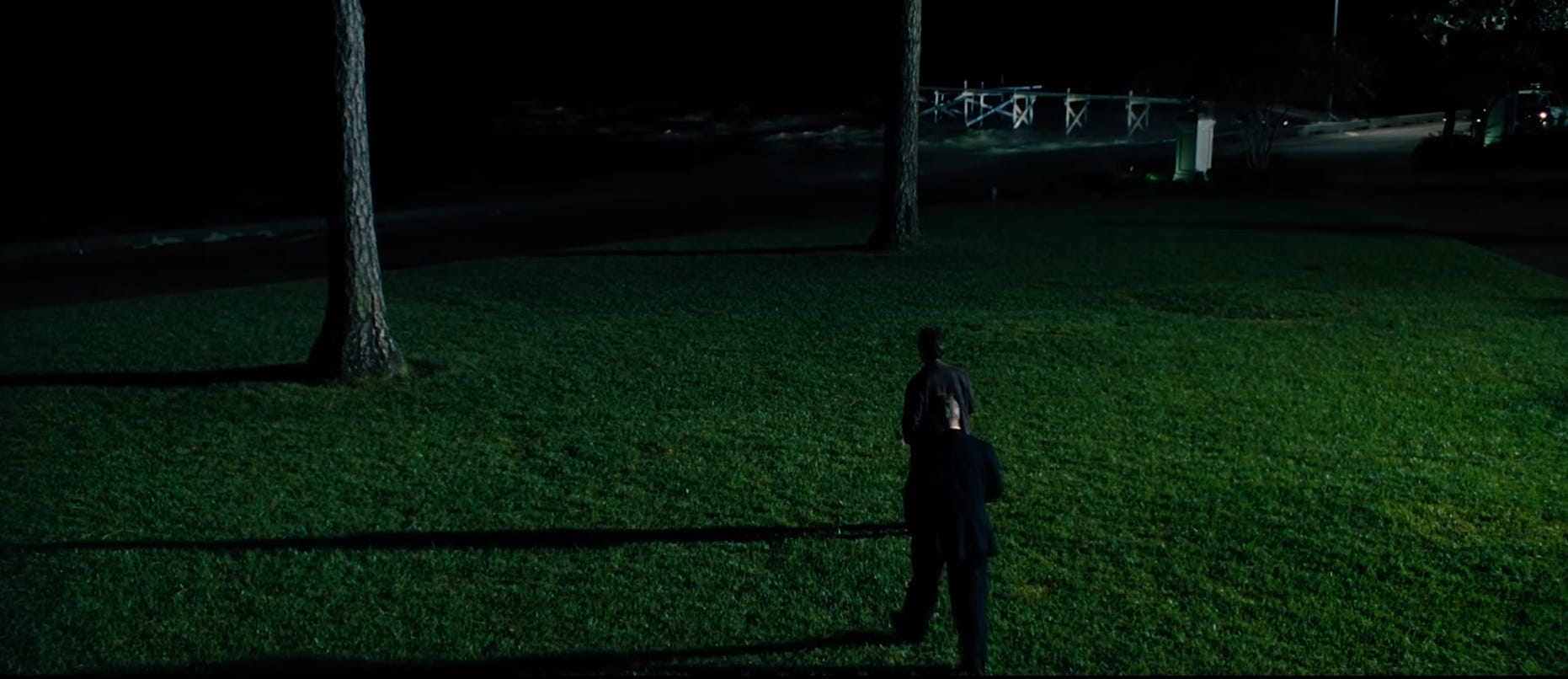
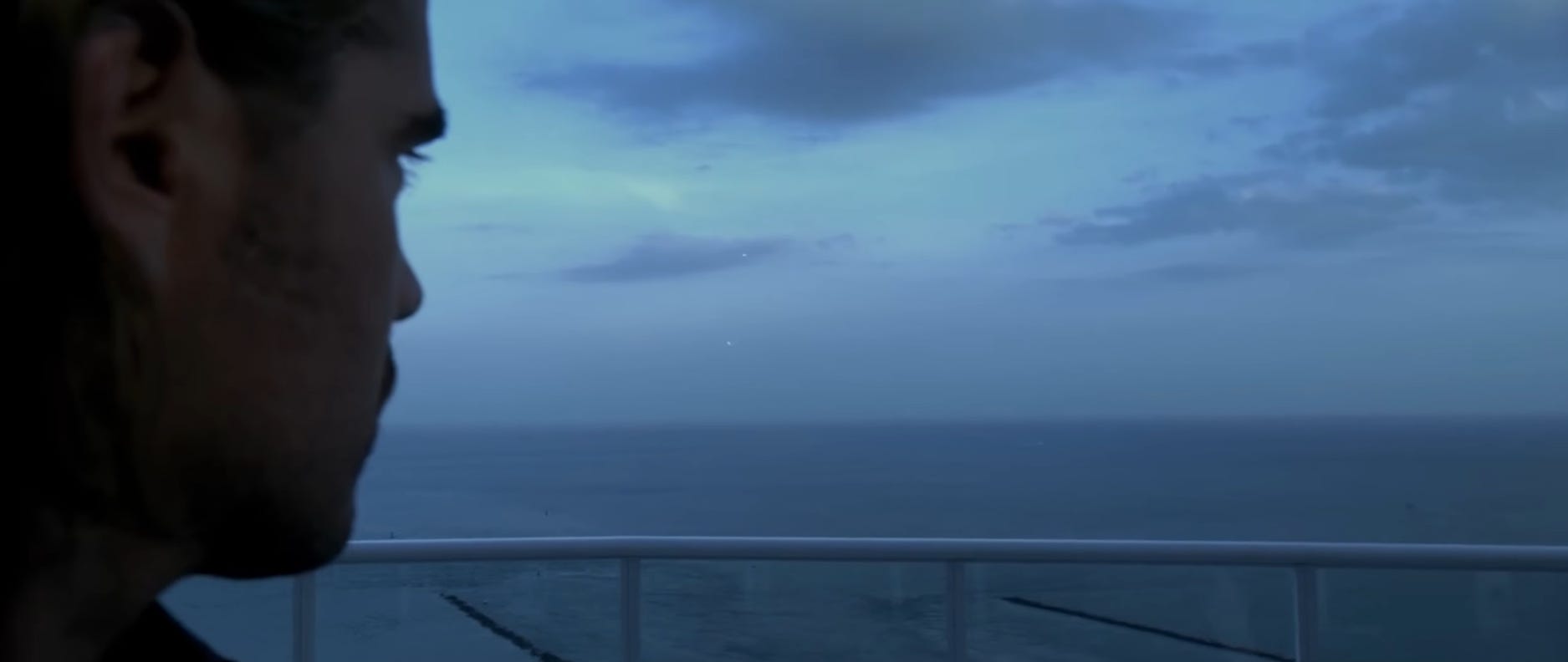
But what makes Mann interesting is that he finds a similar sensation in the systems we have built ourselves. The modern city is beautiful because it dwarfs the people who inhabit it. It is therefore the perfect setting for drama involving alienation and belonging.
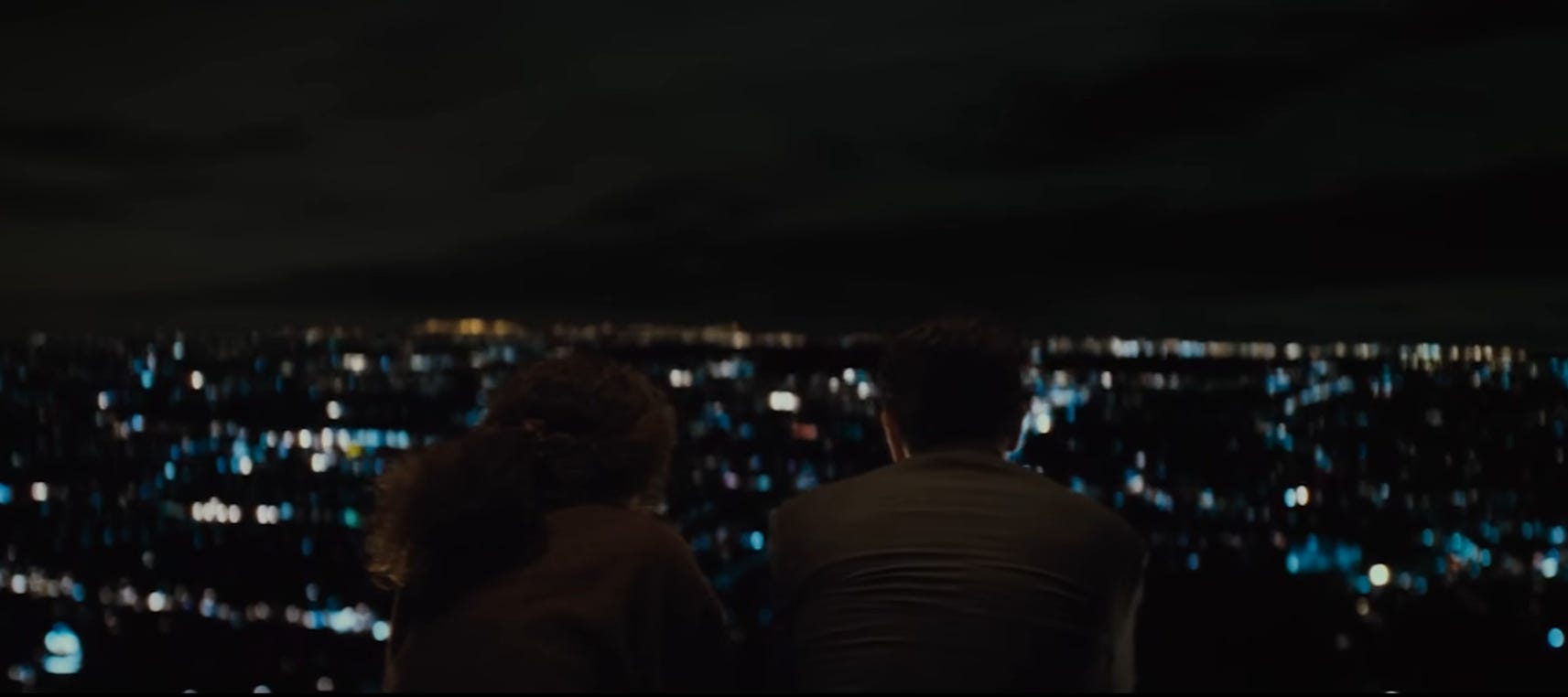
Mann’s technological sublime is most powerful when placed beside the natural sublime. Miami Vice repeatedly combines modern infrastructure with elemental nature: speedboats against open ocean, artificial light reflected on black water, lightning against the skyline. Human drama is made to appear smaller by being suspended between two immense and indifferent systems: the natural world and the technological one. Perhaps this is part of why technological modernity appears so beautiful in Mann’s films. For all its scale and sophistication, it too is diminished when set against the indifference of nature.
These themes are present in Heat, but there is another reason Miami Vice feels evocative twenty years later. Mann presented a forward-looking vision of technological modernity that very quickly came to seem dated. It is a vision of an incoming digital age that is still overwhelmingly physical. Technology creates a globalised world, but it still exists mainly to assist people moving through the world. The characters are constantly driving, flying, crossing water, entering nightclubs. Phones and surveillance technology are used to bolster their work and arrange for in person meetings.
This now feels like a very specific historical moment. All the foundational technology of our era is there, but it’s a time before the smartphone and social media age totally overturned social dynamics and made permanent online presences a feature of life. Miami Vice is a time capsule of 2006, but also of a more optimistic vision of the future that was to come. Technology still seemed to promise a larger world rather than a retreat from it.
That gives the film an innocence it could not have possessed at the time. In embracing everything contemporary, Mann unknowingly captured a brief transitional phase of the digital age that was about to disappear. Facebook opened to the general public just two months after the film’s release; the first iPhone arrived in June 2007; and a year after that came a major financial crisis that punctured much of the confidence and glamour associated with that pre-crash moment.
It’s also worth mentioning that the music choices here are essential. In Heat, Moby’s “God Moving Over the Face of the Waters” gives the final runway scene an almost spiritual quality, turning a cold and purely functional space into something mournful and transcendent.
Miami Vice’s signature music does something very different stylistically. The film opens in the midst of a nightclub scene with “Numb/Encore” playing.
This feels like a quintessentially early-2000s song: a Jay-Z and Linkin Park rap-rock crossover, from a period when collaborations like that were all the rage. Even the specific pairing now feels oddly historically specific. After all, what’s a more early-2000s band than Linkin Park? What’s a more early-2000s rapper than Jay-Z?
But the song also perfectly captures the emotional contradiction at the heart of Mann’s modernity. It was cool, sleek and aggressively contemporary, yet the vocals express a mood of exhaustion and longing. It is, after all, literally called “Numb”: beneath the swagger and wealth is a song about emotional deadness and the desire to escape an imposed identity. That tension fits Mann, and Miami Vice, perfectly. The characters have wealth and access to almost anything, yet seem chronically longing. The music captures that contradiction: all the glamour and momentum of modern life, with a persistent sense of numbness underneath.
Perhaps this is ultimately why Miami Vice has stayed with me, and why it is now undergoing a positive re-evaluation from a new audience, despite its obvious weaknesses. Mann did not try to make a timeless film. Instead, he made the bolder choice of surrendering completely to his own moment and to its assumptions about what the future would look like. Twenty years later, that commitment to the contemporary has made the film more evocative than less, and what once looked aggressively modern now feels strangely quaint. This adds a temporal layer to the experience of unselfing: looking back at Mann’s Miami, we feel not only small against the city and the sea, but small against time.
If you enjoyed this, please subscribe to my free newsletter to get all my future writings.
All my writing is free, and historic censorship means I can no longer received paid subscriptions here.
If you want to financially support my work in the face of recent financial deplatforming, please join the members club, where you can get access to member benefits, including my book Nationalism, the private members’ Telegram, mailbag submissions, and more:
At his 80s/90s peak Mann was like a cross between Terrence Malick and John McTiernan, gorgeous cinematography and music, taut action and deliberate violence. Collateral is partly about the wildness and randomness of things, the will and competence and coldness needed to not merely navigate but master the world, to momentarily bend the endless flowing of desires and fears to your purpose. My favourite Mann is Manhunter, I even kind of structured my novel around it. Mann probably won't make another great film, alas.
Beautifully observed and described. You have a true talent in this field, and a bigger audience than in political discourse.
But still I beg, don’t leave us alone in our struggles