


The American midterms have delivered an astonishing humiliation for Donald Trump, the Republican Party, and the MAGA movement.
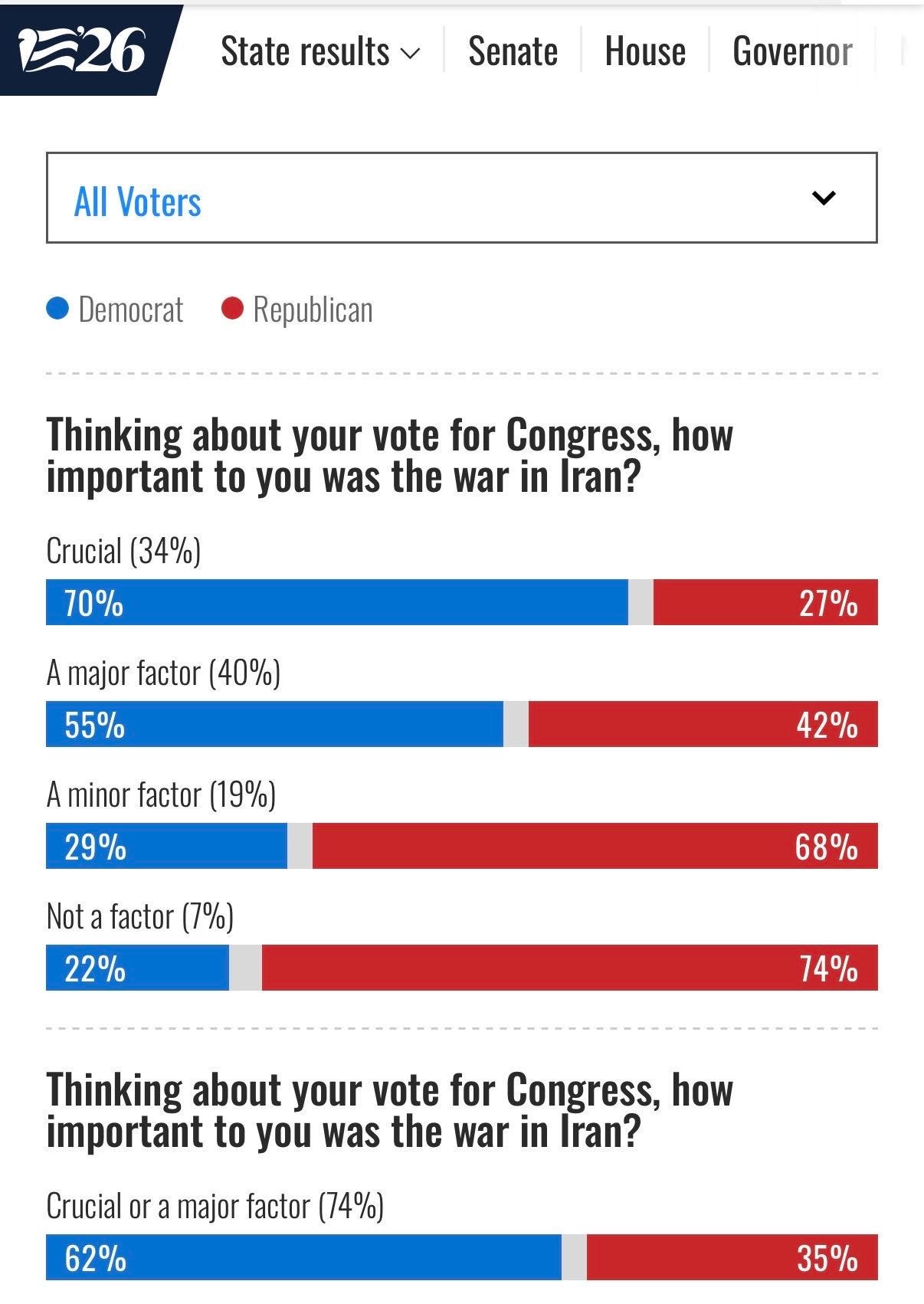
It turns out the blackpillers, doomers, and Israel-obsessive podcasters were right: the Iran War was one of the biggest factors in people abandoning the Republican Party, while immigration enforcement — which “moderate” neocons insisted would hurt the party — was one of the GOP’s few winning issues. MIGA, led by Mark Levin, Laura Loomer and Ben Shapiro, and cheered on by shills like John Doyle and Captive Dreamer, has destroyed the coalition that delivered Trump a historic victory in 2024, spent the right’s political capital on a Purim War for Israel, and silenced and ridiculed anyone sounding the alarm bells about how voters would feel about this. Their consolation, according to the President, is getting Greenland.
This is the latest and worst drubbing the slopulist right has taken on the world stage. In Hungary, MAGA favourite Viktor Orbán has been driven from power after sixteen years, with the late visit of JD Vance and association with MAGA seemingly only hurting him. In Brazil, the Bolsonaro movement has lost another presidential election to an 81-year-old socialist. In Britain, Nigel Farage’s Reform UK has squandered its polling lead so badly that it now trails even the deeply unpopular Labour government by almost ten points.
There is no golden age, the “vibe shift” lasted one election cycle, and it is now time to listen to the blackpillers.
The problem goes much deeper than Trump’s foreign policy or the failures of any of these particular leaders. The populist right has spent the better part of a decade enjoying unprecedented opportunities to challenge the liberal establishment, yet has remarkably little to show for it. Put aside the election wins, the large social media audiences, the tech billionaires switching sides: what has it actually built that will outlast the next election?
A new, Gen Z-friendly left has emerged around figures like Mamdani and Zach Polanski, offering an identifiable set of economic policies that, whatever one thinks of their wider politics, at least presents voters with the prospect of a different future. Wealth taxes, universal basic income, public housing, higher minimum wages, redistribution: these are concrete ideas which promise to improve people’s material circumstances. What is the equivalent offer from the populist right? Generally, it’s socialism for Boomers and bootstrap Puritanism for the youngsters.

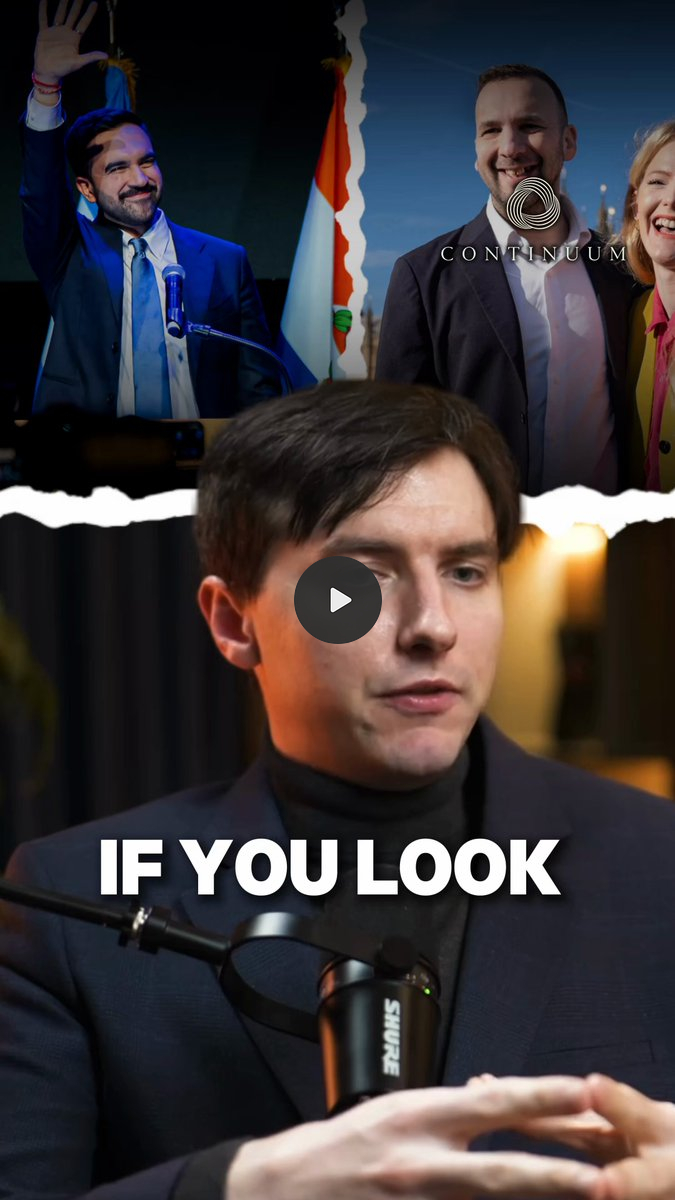
Trump has repeatedly said his goal is to inflate housing prices for Boomer asset holders and Farage is committed to the triple lock designed to endlessly ratchet up Boomer pensions. The GOP tells Gen Z to stop playing video games and go out and work. Farage says young people should stop working from home and be forced to commute to work to their decaying multiracial cities. Things aren't much better among the younger cohort, who vaguely gesture towards immigration restrictions and cuts to left-wing programmes as though these alone constitute an economic programme.
Trump’s signature legislative achievement, the One Big Beautiful Bill, was another shameful exercise in transferring wealth from younger generations to older asset holders. One analysis found that a typical 40-year-old earning around the median income would lose $7,500 in lifetime economic welfare under the proposed bill, while a 70-year-old on the same income would gain $17,500. The final legislation is projected to add trillions to the national debt, with future generations left to bear the costs. His chaotic handling of tariffs hardly offered a more convincing alternative. I’m not against tariffs in principle, but this was once again a policy carried out haphazardly at Trump’s whim, with little long-term planning on reindustrialisation, and repeatedly walked back in response to financial market turmoil.
As much as the Iran War, this economic record was surely a major factor in the loss of confidence in Republican rule. For all the talk of a working-class realignment, what is the grand economic vision behind it? More tax cuts, more debt, and vague promises that tariffs will bring back manufacturing. Once again, populist promises are undermined by a lack of serious intellectual preparation and a coherent economic vision.
But the problem goes beyond a lack of ideas. Even when the right knows exactly what it wants, it has proved remarkably incapable of delivering it. If there was one issue on which virtually every faction of the populist right agreed, it was the threat of deplatforming. Once Trump himself was banned by all the major tech platforms after January 6, it should have been the number-one priority for a Republican administration to create lasting protections against arbitrary online censorship. Trump explicitly promised this in 2022, pledging to reform Section 230 and introduce a Digital Bill of Rights guaranteeing users an explanation and a right of appeal when their accounts were censored or removed. Instead, despite controlling both houses, Republicans were happy to treat that as a settled issue once Elon acquired Twitter, and Meta and YouTube opportunistically walked back some of their censorship of popular conservatives.
The funding of new right-wing billionaires has similarly been blown on transient projects which will leave no lasting cultural influence. Elon Musk alone spent nearly $300 million supporting Trump and Republicans in 2024, followed by an astonishing $474 million on political donations during the 2026 election cycle. That is three-quarters of a billion dollars poured into electoral politics in just a few years, with basically no durable institutional infrastructure to show for it bar a PAC to fund more campaigns. It’s all the more bewildering in Musk’s case, since over the past few years he has repeatedly adopted radical right positions on issues like demographics and amplified the voices of genuine nationalists who are quite some ideological distance from the establishment GOP.
This reflects a deeper asymmetry between the left and the right. The left has a brain. It has a cadre of intellectuals and professional activists who set its agenda and strategy, thinking in lifetimes. Its patrons, likewise, are happy to invest in all manner of cultural projects they feel are in line with their values. The right does not have a brain. It is largely led from the bottom by media trends and desperate attempts to maintain office. Its patrons tend to look at their investments much as they do business investments, and expect an immediate return in the form of seats and access to political power. Or, in Elon’s case, they invest in what seems like a panicked response to the realisation that the left could make their lives extremely difficult when it returns to power, in which case any business-friendly alternative will do. As someone nicely put it recently:
“The left is giving people 100K fellowships for writing lesbian novels, while the right is charging its own guys $200 to listen to some theoretical ramblings about the antichrist.”
Imagine what even a fraction of Elon’s midterm war chest could have accomplished if invested in valuable institutions, publishing houses, film studios, research institutes, or simply developing a new generation of intellectuals. Instead, fortunes are thrown at advertising campaigns and canvassing operations for politicians who would, at best, hold the worst excesses of the left at bay only to be out of office within a few years. The left has spent generations building institutions capable of shaping the culture in which elections are fought. It is not reliant on one election victory or office to expand its influence. And because it has durable institutions and professional activists and intellectuals, it doesn’t have to worry about its cultural power being wiped out by losing an election cycle. Consider the contrast of how many influential right-wing media figures face the possibility of years more of censorship, financial deplatforming, and legal warfare as the Democrats regain power.
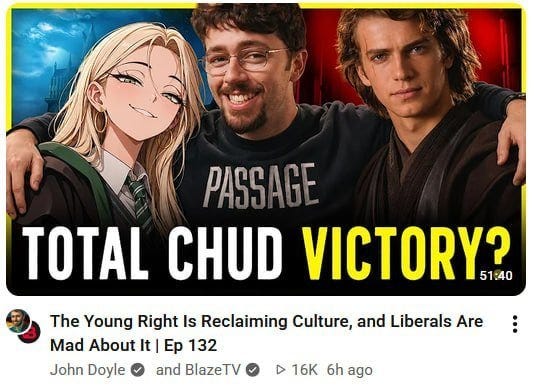
The result of this dynamic is a political culture in which the rewards flow overwhelmingly to whoever can generate the most engagement and flatter the prejudices of an increasingly retarded audience, apparent influence they can then auction off to bloated Boomers who think they’re successfully selling Western values to the young people. An ambitious young conservative can see perfectly well where the incentives lie. Why spend years studying political economy, history or philosophy, producing serious scholarship that few people will read, when he can build a much larger audience by recycling conspiracy theories, or land a gig with the Blaze apologising for the Republican establishment and explaining to Boomers how Gen Z conservatives are reclaiming culture by posting Anakin Skywalker and Draco Malfoy memes.
I generally don’t like to bring myself into these discussions, but here it is relevant. I believe my impact has been not insignificant since I was reinstated to Twitter in 2023. Since then, I began a campaign against Irish hate speech legislation that brought it into public debate here, proved it to be deeply unpopular, and led eventually to the government quietly dropping its proposals. I also launched the Ban The ADL campaign, which led to a huge turn against that organisation, a global discussion about Zionist influence, and a relenting of their efforts against Musk’s X. Across publications, I have one of the most read political newsletters in the world.
As a result of this success, the left responded by placing me under intense censorship. A campaign by the Soros-funded Media Matters led to me losing my YouTube and main source of donations. Leftist organisations successfully had me placed on a Visa blacklist alongside financial scammers and criminals to stop me receiving subscriptions on Substack. Multiple other donation platforms banned me. Then, the U.S. banned me from entry, after an interview where I was quizzed if I was an ethnonationalist. Despite the current administration’s pledge to support European patriots and save European civilisation, no major conservative figures spoke up on this banning, and no one in the administration emerged to undo it. No Con Inc. billionaire responded to my total financial deplatforming by offering to fund my work. None of the conservative media figures who advocate for free speech, and who bandwagonned on the Ban the ADL campaign, commented on me being placed on a Visa blacklist for my political views.
In these circumstances, why would any aspirational young man attempt to influence politics in a rightward direction outside of being a paid mouthpiece for a media organisation? There’s no need to limit it to my case. Nick Fuentes has one of the largest audiences of any political influencer in America, yet apparently no major backer has stepped up to fund an America First institute with the best and brightest of the groypers. Influential nationalists like Martin Sellner are reduced to using crypto and travelling the world to find a reliable bank account. How is it that after a decade of intense leftist censorship, no reliable solution has been found to financial deplatforming?
The personality cult surrounding MAGA has created another contradiction for its European admirers: movements ostensibly committed to national sovereignty have become closely identified with the increasingly erratic foreign-policy decisions of an American president.
Think back to the shameful display at CPAC Hungary, where European nationalist activists stood for the American national anthem to open the conference as the U.S. administration was talking about seizing Greenland from Danish jurisdiction on the whim of Trump, a proposal MAGA talking heads began enthusiastically supporting as a middle finger to Europeans. Parties like Reform UK were burned by their early support of Trump’s Purim War, with the MAGA brand of populism now chiefly associated in voters’ minds with arbitrary wars, corruption and soaring oil prices.
There is then, a silver lining to the crushing Republican defeat. As the exit polls have made clear, and as the Vice President himself has now acknowledged, the chief cause of Republican defeat was the Iran War. Vance publicly breaking with it shows Republicans will be doing all they can all the way up the food chain to wash their hands of that disaster, including perhaps Trump himself. The rage Republicans feel at the results is already being channelled at the Israel First faction which has dominated the policy agenda for years, and Vance has already prefigured 2028 with a message about rethinking America’s relationship with Israel. That would have been unthinkable a decade ago. The failures of slopulism and the Boomer political machine are evident, and everywhere in the West right-wing parties are becoming dominated by identitarians.
The right continues to attract intelligent and idealistic young people, though still not in high enough numbers, and many find themselves institutionally isolated or dependent on establishment right-wing organisations whose priorities they do not share. The right must fundamentally reformulate itself under the leadership of a radical intellectual movement, much as the left was taken over by one in the 1960s. But here, the problem of human capital rears its head again. If most of the right is slop, it’s because that’s what most of the right wants. There is little appetite for sustained intellectual engagement, and the average right-winger’s brain has been so fried by conspiratorialism since COVID that they can hardly engage in critical thought. Many others have taken themselves out of the game with bad theories about impending civil war or violent revolution.
What we need above all, then, is a new political culture fitting for a vanguardist movement, in which independent thought, competence and intellectual seriousness are consciously incentivised and rewarded, and this must eventually translate into a compelling vision and an economic programme capable of offering young people something more than the preservation of their parents’ property values. A simple first step is discarding the plan-trusters and parasites who have attached themselves to the Trump personality cult.
Thanks for reading. I can no longer accept paid subscriptions on Substack, having lost access to Stripe and most other payment processors after being placed on a financial blacklist in a particularly egregious case of ideological censorship. If you would like to support my independent work, please consider making a cryptocurrency donation using one of the addresses below, or contact me directly to arrange an alternative donation method.
Thank you for providing an interesting, insightful and informative article and analysis. Much of which I agree with, though not all. Consensus is nice when it happens, but is not necessary. We are not sheeple or ideological cultists and zealots, as per the Left and Center.
Most of those people that I have met and communicated with a principled, ethical and moral people, individually and collectively, in the main. I have come to the realisation that by and large, populists or "Slopulists" are deeply suspect characters, and are "attention whores and sellouts!" "Never trust a populist, they will always betray you in the end!" Does seem to be very much the case. I think part of the problem with the Right and our mindsets, is that we are "the people who wanted to be left alone", and all that means and implies. Broadly speaking the Right are not interested in seeking to make the world a utopia of "brotherly love and buggery!" We're only really interested in our own little part of it, in effect, "you do you, and I'll do me."
We are not inherently collectivist, as such, though we are sociable to a degree, and we do not have a hive mind, or a relativistic mentality, as the Left and center seems to do. Right and wrong are subjective the Left and Liberals, not objective, as they very much seem to be to the Right. Moral, ethical and social relativistim, reductionism and degeneracy, is inherently antithetical to many if not most of the Right, especially the Dissident-right, as I've heard it referred to.
Nonetheless, we do need a way to effectively strategies, plan, organise and coordinate between the differing factions of the Right, as you've already mentioned and bemoaned, rightly so I think. A broad consensus needs to be reached, agreed and acted upon, the details can be worked out eventually in time, once we have achieved what is necessary for our long-term survival and growth, as the Left have so effectively proven, inspite of the terrible and horrific repeated consequences and outcomes of their ideologies, agendas and policies.
We also need to come up with an effective and workable strategy to deal with the Liberals and Left, which won't leave us, societies and civilisation vulnerable to their mercy and "magnanimosity" if and when they achieve prominence and dominance, and whether or not such is even acceptable to us, and what can and will be done about it?
In the interim, keep up the good work, and may God bless, guide and protect you and yours, along with all those of good faith. Deus Vult 🙏🏻✝️🏴🏴🏴🇨🇮🇬🇧
Great read.