

With the online right discourse still heavily dominated by reactions to Christopher Nolan’s adaptation of The Odyssey, Richard Hanania has chimed in by defending Nolan’s Christianising and liberalising of Homer’s epic with the argument that presenting these epics as Homer intended would be too unpalatable to a modern audience.
In support of this argument, Hanania has been recirculating an essay he wrote on the Iliad, which he argues was mere propaganda for an aristocratic order demanding unconditional obedience from commoners. Unlike conventional authoritarian propaganda, he argues, Homer’s poem does not legitimise a particular ruler by presenting him as exceptionally wise or virtuous. Instead, it legitimises the supremacy of the aristocratic class itself:
The Iliad has a different purpose: to justify the rule of elites as representing the natural order of the world, which in effect means that defending the virtue of past leaders is unnecessary, if not downright counterproductive.
Hanania’s case rests primarily on the treatment of Thersites, the common soldier who condemns Agamemnon’s greed only to be beaten and humiliated by Odysseus. For Hanania, the fact that Thersites is substantially correct makes his punishment especially revealing:
If Thersites were wrong on the substance, then he could be dismissed for that reason. But the fact that he is right and gets beaten for it shows that there’s never a good reason for commoners to step out of line. Only ugly, cowardly cripples dare to criticize their superiors.
He contrasts the fate of Thersites with the freedom enjoyed by Achilles and the other aristocratic warriors:
The Iliad does legitimize opposition to leaders from other elites. Those of sufficient rank can try to convince Paris to give back Helen or Agamemnon to make peace with Achilles, but they can only rely on the power of persuasion. Commoners don’t even get that; all they can do is obey.
Remarkably, toward the end of Hanania’s essay he writes:
It seems doubtful that I would come up with a brand new theory about The Iliad, but I’ve looked around a bit and haven’t found anyone making a similar argument.
For a more humble scholar, this reflection might have prompted him to consider a simpler explanation for the apparent originality of his theory, other than his own extreme intellectual brilliance: Homer’s audience required no elaborate justification for hierarchy in the first place. Scholars of the Bronze Age and archaic Greece understand that hierarchy formed the background of Homer’s world, taken for granted much as we take for granted that generals outrank privates. To call the Iliad propaganda for aristocracy because it reflects aristocratic assumptions is like calling every modern military film propaganda for its chain of command.
America's AI Gamble

Keith and Ryan discuss America’s enormous gamble on artificial intelligence. From record AI investment, data centres, and the growing weight of the sector in the US economy to China’s rapidly improving open-source models and the possibility that cheaper systems could erode America’s lead. How reliant has the US economy become on the AI boom? Can China c…
This does not mean that Hanania has imagined the hierarchy he identifies. The freedom depicted by Homer is unmistakably aristocratic rather than universal. Homer’s commoners possess nothing resembling modern political equality, and Thersites plainly lacks the freedom to challenge Agamemnon enjoyed by Achilles.
Hanania may therefore be right that obedience was effectively unconditional from below, but he mistakes this for an aristocratic order imposing no corresponding conditions from above. Rank granted privileges, but it also imposed demanding obligations upon its possessors. It does not follow from the political subordination of commoners that aristocratic status was itself unconditional, or that Homer treated birth as sufficient justification for whatever a prince chose to do.
Support my work and get access to member benefits, including my book Nationalism, the private members’ Telegram, mailbag submissions, and more:
Ricardo Duchesne places this principle within what he calls the “aristocratic egalitarianism” of the Indo-Europeans. He introduces this concept in The Uniqueness of Western Civilization, which is a useful corrective to Hanania’s understanding. Indo-European societies were not egalitarian in the modern sense: freedom and public recognition belonged principally to a warrior elite. But they were not organised around the unconditional sovereignty of a god-king, the political model of the Orient. Authority was dispersed among competing chieftains, each of whom depended upon the recognition of other proud and independently powerful men:
It is in aristocratic societies that we first discover characters zealously preoccupied with their honor and future name, with the judgment of other “masters” regarding their courage, skill in war and in the hunt.1
In the Iliad, the clearest expression of this conditional aristocratic ethic appears in Sarpedon’s speech to Glaucus in Book XII. Sarpedon asks why they receive the finest seats, meat, wine and estates in Lycia. His answer is not that noble birth entitles them to unconditional deference. Their privileges oblige them to stand among the foremost fighters, where they assume the greatest risk of death:
Glaucus,
why do they hold us both in honor, first by far
with pride of place, choice meats and brimming cups,
in Lycia where all our people look on us like gods?
Why make us lords of estates along the Xanthus’ banks,
rich in vineyards and plowland rolling wheat?
So that now the duty’s ours—
we are the ones to head our Lycian front,
brace and fling ourselves in the blaze of war.2
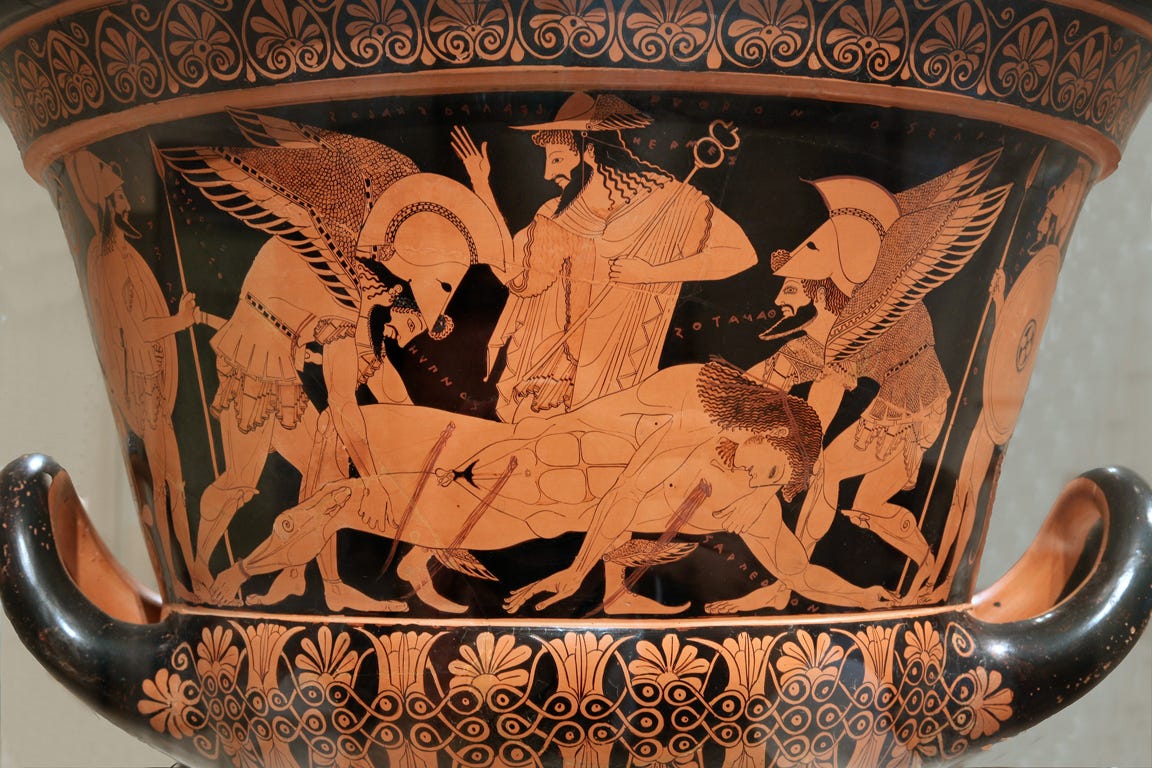
The people of Lycia, Sarpedon continues, should be able to say that their rulers owe their position to their own demonstrated excellence:
Not without fame, the men who rule in Lycia,
these kings of ours who eat fat cuts of lamb
and drink sweet wine, the finest stock we have.
But they owe it all to their own fighting strength—
our great men of war, they lead our way in battle!3
Sarpedon then gives the ultimate reason for accepting this danger:
Ah my friend, if you and I could escape this fray
and live forever, never a trace of age, immortal,
I would never fight on the front lines again
or command you to the field where men win fame.
But now, as it is, the fates of death await us,
thousands poised to strike, and not a man alive
can flee them or escape—so in we go for attack!
Give our enemy glory or win it for ourselves!4
Sarpedon neither denies hierarchy nor treats privilege as unconditional: those who receive more must risk more. The finest estates, food and wine impose an obligation to lead with bravery from the front.
The poem also distinguishes sharply between the nobleman who fulfils this standard and one who fails it. When Paris retreats at the sight of Menelaus, Hector does not defer to him merely because he is Priam’s son:
Paris, appalling Paris! Our prince of beauty—
mad for women, you lure them all to ruin!
Would to god you’d never been born, died unwed.
That’s all I’d ask. Better that way by far
than to have you strutting here, an outrage—
a mockery in the eyes of all our enemies.5
Hector then attacks the discrepancy between Paris’s appearance and his actual worth. The Greeks mistook him for Troy’s “bravest champion” because of “the handsome lustre” of his body, but he possesses “no pith, no fighting strength inside.” His inherited standing and divine gifts cannot save him from disgrace if he lacks the courage expected of a prince.
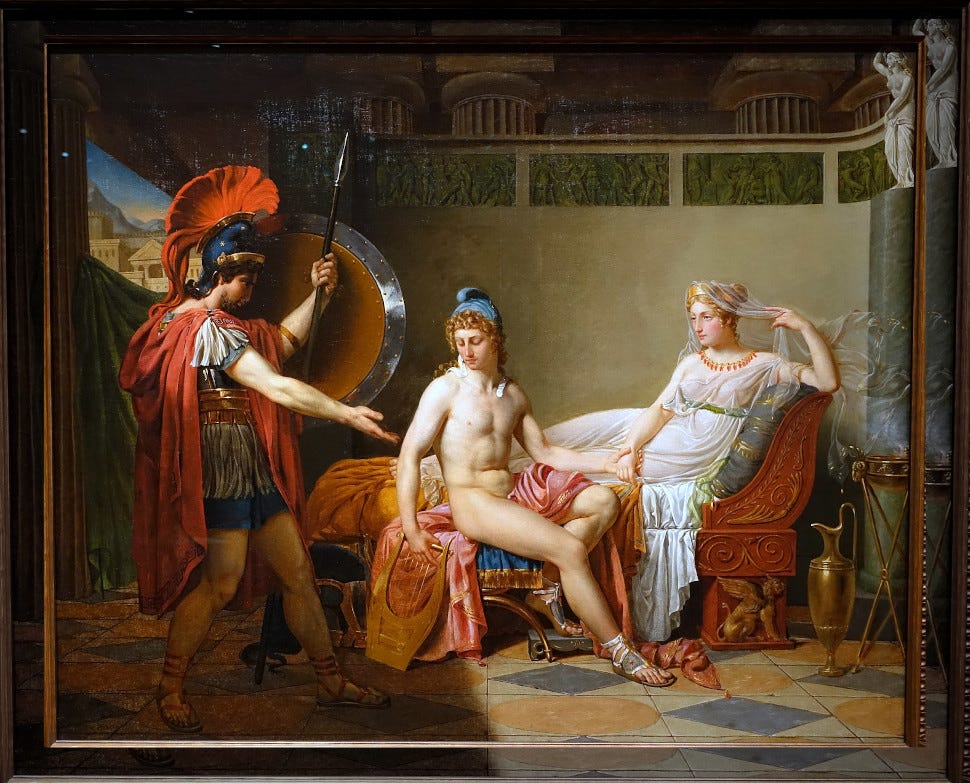
Both are princes, but their birth does not confer equal honour upon them: Sarpedon vindicates his position through courage, while Paris disgraces his by shrinking from its obligations. Homer’s contempt for Paris is difficult to reconcile with Hanania’s portrayal of him as a mere propagandist for aristocratic privilege. Unlike the court literature of the ancient Orient, which concentrated glory in a god-king whose rank itself testified to his greatness, the Iliad exposes the gulf between Paris’s princely birth and his personal worth. Homer assumes aristocratic rule, but he does not flatter aristocrats: he subjects them to a demanding heroic standard and openly humiliates those found unworthy of their position.
That standard is aretē, the governing principle of Homeric aristocracy in Duchesne’s account. The word denotes excellence, nobility, success and the reputation produced by them; it shares its root with aristos, “the best.” As Duchesne writes:
To strive always for the highest aretē and to excel all others in battle is the governing theme of this epic.6
Homeric society was not meritocratic in the modern sense, since noble birth largely determined who could enter the heroic competition. But neither was noble status understood as an arbitrary privilege unrelated to ability. One of the top comments on Hanania’s essay rightly points out that aristocratic birth brought superior nutrition, military training, political education, leisure and experience from childhood — advantages that produced men visibly better equipped to lead and fight.
What is genuinely strange and noteworthy is not that aristocratic rule is accepted, something taken for granted in the ancient world, but the distinctly Indo-European character of Homeric aristocracy: kings are not god-rulers possessing an unquestionable monopoly on authority and glory, but first among competing chieftains who must continually vindicate their rank before other proud and independently powerful men. The poem does not ask whether kings and commoners are equal; it asks which princes are worthy of their inherited rank. Sarpedon vindicates his position by leading from the front, while Paris disgraces his by shrinking from its obligations.
Nor were the ordinary Greeks simply modern conscripts forced to die for a ruling class from which they received nothing. The Achaean host more closely resembled a coalition of aristocratic war bands, attached to particular chiefs and united by the prospect of conquest and plunder. The common warriors occupied subordinate positions within the same heroic economy. They received smaller shares of its rewards, but they were also its beneficiaries rather than merely external victims of Menelaus’s private quarrel.
Hanania therefore assumes too sharp a separation between the interests of the chiefs and their followers. The hierarchy advantaged Agamemnon most, but victory promised spoils, captives and prestige throughout the army. Homer did not need to invent a modern national cause to explain why the Greeks fought, because loyalty to one’s chief, participation in a successful expedition and the expectation of plunder were already intelligible motives to his audience.
Hanania sees the inequality of this order clearly but reduces its internal ethic to a mechanism of class domination. He notices that Thersites must obey, but pays insufficient attention to what Sarpedon must do to deserve honour, what Paris fails to do despite his birth, and what ordinary warriors expected to gain by following their chiefs. Duchesne restores the missing half of the picture: obedience below was paired with competition, judgement and mortal risk above. Hanania may be right that the commoner possessed no recognised right of resistance; he is wrong to infer that aristocratic privilege was therefore unconditional or unrelated to merit.
Elsewhere, Hanania has invoked the rank injustice of Homeric morality to defend Nolan’s transformation of it into a modern Christian morality tale. But an adaptation need not endorse every feature of the Homeric world to represent its moral logic honestly. The hierarchy, cruelty and exclusion are inseparable from an aristocratic ethic that also demanded courage, excellence, self-sacrifice and contempt for rulers who failed in their obligations. Hanania and Nolan both view this through an intolerant liberal lens and reduce this strange and demanding moral universe to little more than an ancient class racket. Contra Nolan and Hanania, a great adaptation would confront modern audiences with that difference. Their shared failure is one of imagination: neither can conceive of entering a moral world radically unlike his own without first remaking it in the image of modern liberalism.
Thanks for reading. I have recently experienced the worst case of financial censorship yet, losing access to Stripe and most payment processors due to being placed on a blacklist. This is a grave case of ideological censorship and “debanking.”
If you want to continue to support my work please join the members club, where you can get access to member benefits, including my book Nationalism, the private members’ Telegram, mailbag submissions, and more:
Ricardo Duchesne, The Uniqueness of Western Civilization (Leiden: Brill, 2011), 344.
Homer, The Iliad, trans. Robert Fagles (New York: Penguin Books, 1990), Book XII, 335.
Ibid
Ibid
Homer, The Iliad, trans. Robert Fagles (New York: Penguin Books, 1990), Book III, 129–30.
Duchesne, The Uniqueness of Western Civilization, 447.
Hanania is an idiot who is not worthy of our attention. Still, good debunking of his latest attempt to crawl back up the arse of liberalism.
Superb