

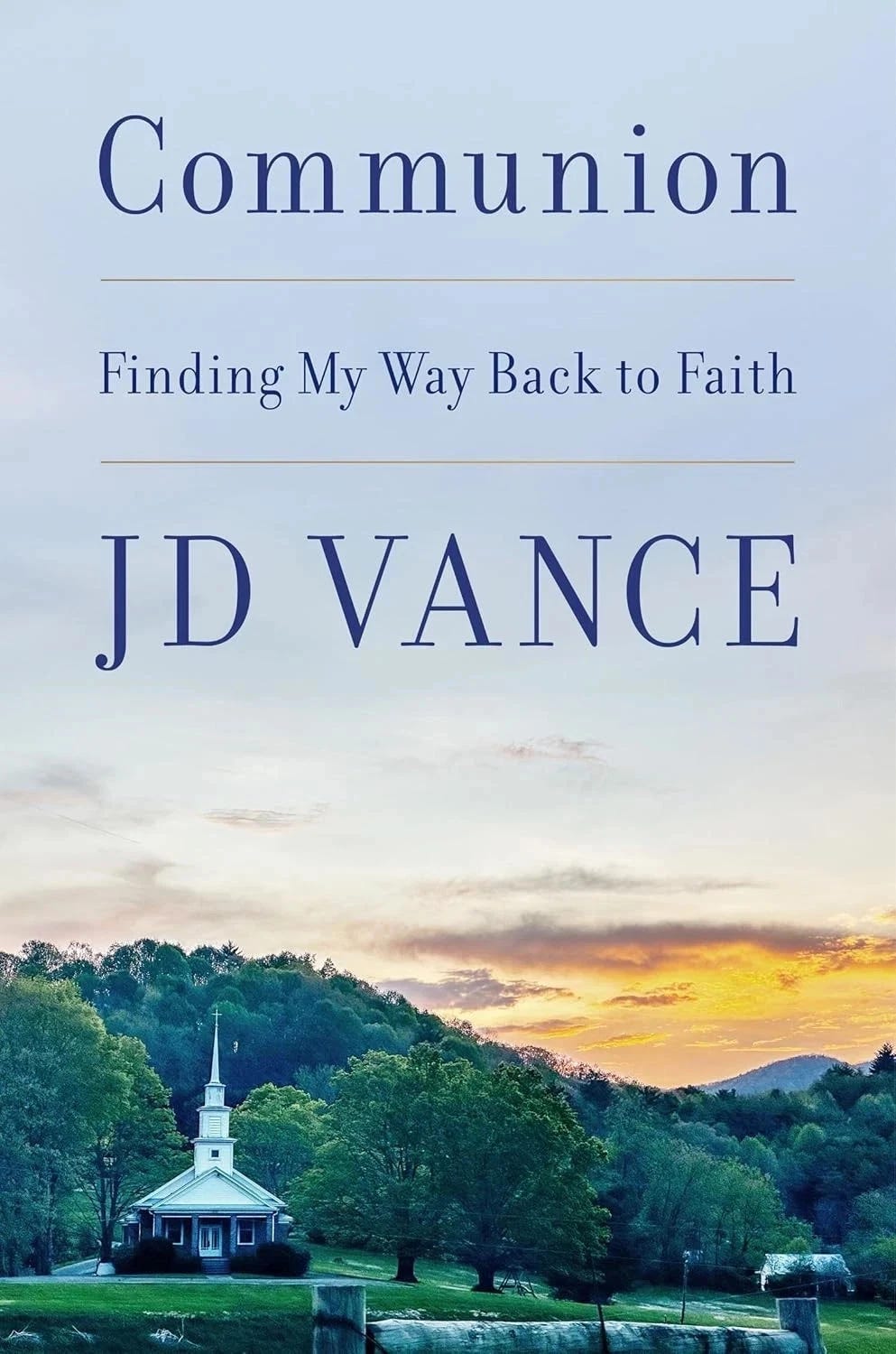
“What’s the Matter with JD Vance?” is the title of the opening chapter of the American vice president’s recently released religious memoir, Communion: Finding My Way Back to Faith. After reading the book, I find myself considerably more interested in this question than in any of the answers Vance offers about Christianity.
Vance is clearly a very intelligent and competent man. He is also capable of engaging seriously with the philosophical questions around faith, and the best intellectual challenges to his religious belief. Yet there is something peculiar about his intellectual development, first from his childhood evangelical Christianity to atheism, and then back to Christianity via Catholicism. There is little in Vance’s testimony that is compelling as a form of Christian apologetic, but it does offer an interesting psychological portrait, and something of a puzzle in attempting to distinguish between the intellectual reasons Vance gives for his beliefs and the personal and social influences that seem much stronger.
Vance’s troubled upbringing has been well documented, and was the subject of his bestselling book Hillbilly Elegy. It was an upbringing marked by considerable instability and, presumably, trauma, with Vance’s father absent and his single mother struggling with addiction. His grandmother, whom he affectionately calls Mamaw, eventually steps in to fill the role of a stable parental figure in his life. Mamaw was a devout Christian, but had little interest in institutional religion. For her, Vance tells us, Christianity was less a matter of theological doctrine than a set of moral obligations, especially to one’s family. Vance absorbed this understanding of Christianity and only became involved in a church community after eventually reconnecting with his biological father and joining his Pentecostal congregation.
Vance’s eventual abandonment of Christianity coincided with his movement away from this world. Vance writes that Mamaw was the last person keeping him anchored to Christianity. After her death, and through his service in the Marines and subsequent entry into Ohio State University, he gradually lost his attachment to the religion of his childhood. He describes discovering powerful intellectual objections to his evangelical faith associated with the current of New Atheism growing popular at the time, particularly the difficulty of reconciling biblical literalism with evolution.
But he was more affected by a moral argument, becoming increasingly contemptuous of what he regarded as the hypocrisy and empty promises of evangelical Christianity. He recalls his disgust at the spectacle surrounding the Terri Schiavo controversy, a legal battle over whether to remove the feeding tube of a severely brain-damaged Florida woman, which became a cause célèbre among evangelical Christians and conservative politicians. The disgust was compounded by a young JD observing that the ordinary suffering of people in communities like his own attracted little sympathy from the same religious leaders.
There were some intellectual influences. He recalls reading Christopher Hitchens and Sam Harris, but in retrospect attributes his original break with Christianity less to philosophical reasoning than to his growing disillusionment with the Christians around him. His subsequent immersion in the secular culture of America’s educated elite only reinforced this estrangement. In a revealing essay he wrote about his conversion in 2020, Vance says his attachment to New Atheism “came down to a desire for social acceptance among American elites.” This will become a recurring theme in Communion.
Vance quickly found a new moral framework shortly after dropping his Christianity. He describes a rapid embrace of the philosophy of Ayn Rand after reading Atlas Shrugged in his time in the Marines:
I didn’t care about God’s will. I cared about my own. I cared about winning, never having to worry about money again, and having the type of job that commanded respect.
As he entered university, Vance more explicitly embraced atheism to fit in with his new social circle of aspirational elites. This created an uncomfortable distance between himself and the family and community that had raised him. Vance compensated for this split by becoming an enthusiastic libertarian and embracing the economic orthodoxy of the Republican Party, which he says occupied a religious role in his life.
The irony, which Vance himself acknowledges, was that these were precisely the aspects of conservatism that interested his working-class family the least. But economic libertarianism allowed him a kind of middle ground where he could preserve some sense of continuity with his conservative upbringing without keeping any of the elements of it that seemed crass to his educated peers. So, just as his embrace of atheism conveniently helped him adopt a new social identity, his libertarianism conveniently helped him reconcile his older identity.
Vance’s tendency to adopt the values of whatever social environment he found himself in becomes even more pronounced as he discusses ascending the American educational hierarchy, a journey which eventually brought him to Yale Law School. What is remarkable about his account of this period is how little thought he seems to have given to his values or what he actually wanted from life. He describes preparing obsessively for his LSAT entrance exam and tirelessly pursuing admission to the most prestigious law school he could find, despite having no particular interest in becoming a lawyer.
I don’t regret the work I put into college or the time I spent studying for the LSAT, but it is scary to consider how much motivation I had to achieve a goal I didn’t understand. I had no idea why I wanted to go to law school or what I wanted to do with my life. In my atheism, I fancied myself enlightened and rational. Yet all of my talents and energies were focused on obtaining, at best, a good option to guarantee financial security and, at worst, the prize in a competition I was unable to comprehend. As much as I thought the ideas in my head were the consequence of reasoned consideration, I made the most important decision in my life thus far almost entirely based on the priorities of my environment.
It’s understandable someone who had experienced poverty and insecurity in his childhood like Vance would feel compelled to seek wealth and status as an adult, but it’s quite remarkable that he claims to have devoted no real thought to the direction of his life, even at the point of completing his time in the Marines and entering a prestigious law school. What’s even more remarkable is how easily he is snapped out of this unthinking pursuit of wealth and status.
It was during Vance’s time at Yale that he attended a lecture by Peter Thiel, which he expected would be a motivational speech about Thiel’s business achievements. Instead, Thiel shook Vance by delivering a critique of the pointless competition for status that consumed America’s educated elites. Thiel argued people like Vance were devoting themselves, at an increasing cost of time and social alienation, to prestigious but ultimately unfulfilling careers that did little to advance society.
Peter gave voice to something I had been feeling, but had not fully understood: that I was obsessed with achievement per se—not to accomplish something meaningful, but to win a social competition. I had prioritized striving over character, and for what was I even striving? I didn’t even know why I cared about the things I cared about.
Vance was so struck by this that he says he immediately began preparing for a career outside law. But there was another, even more profound way that his encounter with Thiel shaped him:
Possibly the smartest person I’d ever met, he identified very openly as a Christian. He defied the simple social template I had constructed—that dumb people were religious and smart people were atheists.
Discovering that someone of Thiel’s stature could be a sincere Christian was enough to overturn the simple association Vance held between intelligence (and status) and atheism, which prompted him to investigate the religious and philosophical influences on Thiel’s thinking. Thus begins JD Vance’s re-engagement with Christianity which will eventually lead him to Catholicism. At this point, Vance begins discussing some of the intellectual influences on him returning to the faith.
Vance discovered that Thiel’s Christianity was influenced by the work of René Girard, a French philosopher known for his theory of “mimetic desire”: the idea that human beings acquire many of their desires through imitation or “mimesis” of others. This resonated with Vance, who immediately recognised this in his own experience of elite competition. He had wanted prestigious credentials and jobs because other people wanted them, and he now began to recognise that the same process could influence intellectual convictions like his atheism.

There is more than a little irony in Vance finding Girard’s theory of mimetic desire after it received an endorsement by the most prestigious man he had ever encountered. Having spent years unquestioningly pursuing elite approval, Vance only seriously questions this ambition when someone even more successful challenges it. This raises the question that shadows the rest of the book: has Vance really escaped the influence of mimetic desire on his thinking, or has he merely exchanged one set of intellectual authorities for another?
Throughout the rest of the book, Vance does little to quell these doubts. He does engage with the worldview of Catholicism and its critics, but this never takes the form of a positive case for the truth of his religion. Instead, he describes a process of overcoming his objections to Christianity and discovering how morally appealing and intellectually sophisticated its account of the world is. Girard offers an explanation of human behaviour and reframes Christ’s sacrifice in a way he finds compelling, Augustine helps him reconcile Christianity with modern science by showing a literalist interpretation of Genesis is unnecessary, and the lives of admirable Christians convince him of the practical merits of their faith in much the same way as the hypocrisy of evangelical leaders first turned him against it.
Of course, it may be true that biblical literalism is a misreading of scripture, that Christ’s sacrifice uniquely inverts the Girardian scapegoat motif found in ancient civilisations, and that Christianity encourages people to live more moral lives. But none of this, however compelling, establishes the truth of Christianity's central supernatural claims. Vance explains how he came to appreciate the moral and sociological insights of Christianity, but gives us little indication of what persuaded him that its central doctrines were actually true. Towards the end of the book, he does offer something closer to a positive case, appealing to the remarkable historical continuity of the Church and the conviction of the early apostles. But neither of these are likely to be compelling to a skeptic, and seem more like justifications he has reached after his conversion than arguments that played any significant role in bringing him to believe in the first place.
The same is true of his own personal religious experiences. A review of Vance’s book for The Atlantic amusingly wrote “If I were Vance, I would be a little offended that God was not putting in more effort to recruit me.” These efforts include Vance losing control of his car on a wet mountain road, only for it to come to an inexplicably gentle halt before striking a guardrail. On another occasion, a wineglass seemingly leapt from a shelf while he was discussing Catholicism with a friend. He also describes hearing the same psalm performed in two different languages on the same day, which he took as a possible sign from God.
To be fair, Vance does say at the outset that this is not a work of apologetics, but surely even a memoir about a personal journey back to faith would explain why its author came to believe that faith was actually true. Instead, the reader is given an account of why Catholicism became morally fulfilling to the author. The question of what he wanted to believe seems to take precedence over the question of what he had good reason to believe.
A telling passage as it relates to Vance’s mindset on this is contained in his 2020 article on his conversion, where Vance wrote of being struck by a powerful critique Saint Augustine made of the inequality in Roman society:
And indeed it was this insight, more than any other, that ultimately led not just to Christianity, but to Catholicism. Despite my Mamaw’s unfamiliarity with the liturgy, the Roman and Italian cultural influences, and the foreign pope, I slowly began to see Catholicism as the closest expression of her kind of Christianity: obsessed with virtue, but cognizant of the fact that virtue is formed in the context of a broader community; sympathetic with the meek and poor of the world without treating them primarily as victims; protective of children and families and with the things necessary to ensure they thrive. And above all: a faith centered around a Christ who demands perfection of us even as He loves unconditionally and forgives easily.
What finally wins over JD is not any transformative religious experience or apologist argument for God or the gospels, but his discovery of Catholicism’s apparent correspondence to the moral worldview of his grandmother, the woman who had provided the only real stability in his childhood, and whose death had first severed him from his faith.
It’s very telling how often Vance returns to his childhood, and his attachment to the figures that provided his chaotic upbringing with some stability. At one point in the book, Vance admits:
I am permanently terrified that things will unravel. My life quite often feels like a fairy tale, and I am certain that soon the story will end.
One of the common consequences of growing up with unreliable parental figures is difficulty developing a stable sense of self, leaving a person unusually dependent on others for the validation and direction that were missing in childhood. That’s not to say people cannot overcome troubled childhoods, and I don’t want to dismiss Vance’s intellectual development by claiming to understand his motives, but as this book progresses a very noticeable pattern emerges of someone who repeatedly, and sometimes radically, changes his convictions after encountering people and institutions he admires.
His grandmother provides his original moral compass, the educated elites supply a new ideal of intellectual sophistication, Peter Thiel upends his assumptions by showing someone even more elite is dismissive of his beliefs about success, and Catholicism eventually offers an enduring source of moral authority which he feels integrates the guidance of his Mamaw. Is Vance intellectually and morally progressing, finding more egoistic pursuits lacking and directing himself to higher things, or is he just finding new authorities around which to organise his identity?
No one can see inside JD’s mind from a memoir, but in this regard I found one conversation Vance recounts particularly interesting. He recalls that the Catholic priest who guided his conversion unexpectedly challenged him for being “too emotionally invested” in his wife Usha (whom Vance spends many pages of the book celebrating.) Vance’s priest warns him “Your entire life you have bounced between complete dependence and independence.” His grandmother had served as a kind of saviour during his childhood, and the priest warns him that he is now assigning the same role to Usha.
Neither woman, the priest explains, can bear the burden of providing his ultimate security and salvation, a role that must be reserved for Christ. JD is taken aback by this, but soon realises his priest is correct:
It was one of those truths that annoys you because it was, in fact, pretty damn accurate.
It doesn’t seem like a great stretch to see a parallel between this pattern in Vance’s personal relationships and his approach to ideas. Throughout his intellectual development, he seems to alternate between an insistence on his independence of thought and a remarkable receptiveness to the influence of people he admires.
Another notable pattern in Vance’s account is the change in his description of his behaviour after his conversion. Earlier in the book, Vance is candid in presenting his younger self as an almost pathological striver driven to maximise status at all costs. After his conversion, momentous events in his life are described in a more passive manner, as if JD is just being carried along by the grace of God into remarkable situations he never imagined. Peter Thiel is portrayed as a huge influence on his intellectual and spiritual life, but it’s not mentioned that he later backed Vance’s Senate campaign to the tune of $15 million, a campaign that Vance presents quite casually as “a quirky intellectual project” which he expected to lose:
Much has been written about that Senate race, and I doubt I can offer much original here. But the most important thing to say is that I thought we’d lose but we didn’t.
Another event that just sort of happens to Vance is his selection as Donald Trump’s running mate and eventual ascent to the vice presidency. Vance says he was shocked to learn he may be on the shortlist, thinking the initial vetting call was a prank, but considered it a longshot and put it out of mind. But Vance had long been discussed as a leading contender, and was supposedly on a final shortlist with Marco Rubio and Doug Burchum weeks before his eventual selection. The campaign itself is condensed to a single line:
The president and I won the election, and I became the Vice President of the United States.
Perhaps Vance really has overcome the compulsive ambition that once dominated his life, and it may just be a simple editorial choice to not devote much of a spiritual memoir to his post-conversion political career, but it is conspicuous that the relentless striver of earlier chapters now finds himself ascending to the highest reaches of political power almost by accident, with little of the searching self-examination he applies to his earlier ambitions.
In the final two chapters of Communion, Vance turns to politics. Displaying the economically populist conservatism he has come to represent, he takes aim at “the dismal science” of economics, recounting a trip to Japan where, despite learning from economists that Japan was economically stagnant, he was struck by its cleanliness, safety and general quality of life. He wonders how a country performing so poorly by conventional economic measures could appear to offer so much that makes life worth living. After tasting the best strawberries he’s ever had and realising $6 of Japanese strawberries contributes exactly as much to GDP as $6 of inferior American strawberries, he jokes that his takeaway from the trip was “maybe economics is just fake.”
It’s noble to push back against the kind of economism that has long characterised mainstream conservatives, but Vance’s views rest on quite a fantastic strawman of mainstream economists straight out of tradcon Twitter. The reader is told that economists value only raw GDP growth at all costs, ignoring things more relevant to people’s quality of life — in reality, there are entire fields of economics devoted to these kinds of questions, with Nobel Prize-winning economists penning books about the “mismeasure” of GDP. Vance's Japanese strawberry example is only a challenge to a very crude understanding of economics that scarcely anyone in the discipline would endorse.
Vance then discusses his disagreements with Church leadership over immigration, beginning with a statement issued by the United States Conference of Catholic Bishops. Vance praises the statement as “admirably measured,” but complains that it, like many Church statements on the topic, offers little practical guidance or seriously weighs the competing moral goods of enforcing the law and respecting the dignity of migrants. In fact, the “measured” statement forcefully condemned mass deportations and the “climate of fear” immigration enforcement created, and lamented the administration separating migrants from their loved ones. The bishops were making a principled objection to the administration’s enforcement policies, not the vague condemnation of cruelty Vance suggests.
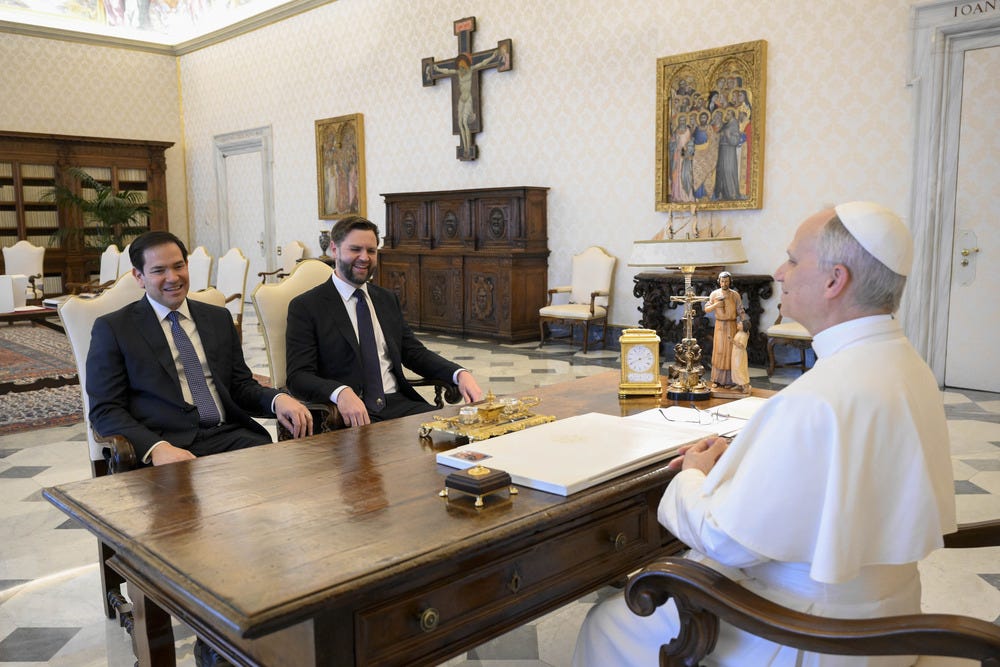
He expresses similar frustration with Vatican diplomats, who urged the humane treatment of migrants without specifying which American policies they opposed. Like many right-wing Catholics, Vance struggles to reconcile his understanding of the Church as the guardian of an enduring moral order with its political pronouncements, which seems indistinguishable from human rights universalism.
None of this is to suggest that Vance’s conversion is insincere, or that he has not undergone genuine intellectual and moral development — if you set aside the question of his vaulting political ambition, he comes across as a basically decent guy. Nor does the fact that a religion satisfies deep psychological needs constitute an argument against its truth. Indeed, you should reasonably expect a true account of the human condition to speak to our deepest needs and anxieties.
But there is a difference between finding a worldview that satisfies our deepest instincts and establishing good reasons to believe it is true. Communion offers very little of the latter. Instead, we get an explanation of what in Catholicism appealed to JD Vance, which is, finally, a religion that makes sense of his childhood, reconciles him with the people he loves, and gives direction to his ambitions and the promise of an enduring moral home. In the end, Communion is more interesting as a psychological portrait of its author than as a defence of his faith.
Thanks for reading. If you enjoy my writing, check out my new book, The Gnostic Question:
The Gnostic Question

I am delighted to announce the release of The Gnostic Question, a book I have co-authored with Richard Storey.
Excellently done. I find it especially odd that the VP’s “return to Ithaca” brought him across the Tiber rather than to any other denomination. It’s not as though biblical literalism is the norm outside of the RCC. Roman Catholicism is also the most “elite” modern denomination of Nicene Christianity, and it’s interesting that he doesn’t seem to address the tensions between that and his broader populism / fixation on his American heritage. Or his attempt to distance himself from the status-chasing that once plagued him, for that matter.
It still feels like he’s trying not to offend anybody, avoiding picking any fights. He isn’t forward about fighting to be vice president or senator (or president), he flattens theological differences, and minimizes his disagreement with CST regarding immigration. He focuses on subjective and identity-based reasons for his faith, too, instead of more objective arguments.
I wish he’d put forward a more forceful and ambitious vision of faith and for America. This feels soft.
Fair assessment, but the whole "Reversion to childhood" critique doesn't sit well with me. You can bring up the general statement, "everyone is a sum of their experiences", yet this says particularly nothing about the world.
All of us are attracted to certain ideas in the same manner— they resonate with us on a spiritual level. We as nationalists understand this, and in fact, this is the essence of our conservatism. Vance's "return to Mamaw" can be fractally mirrored as the turn towards one's national roots.
We belong to a particular people's and our way of being discloses the world around us in a manner dictated by the national body we belong to. This belonging stretches beyond our lifetime and is always brining us towards a certain telos. Thus, conservatism is the innate feeling associated with this fact, which assigns us with our moral guidance.
Taking the above into account, Vance's seeming turn towards the past isn't something to look down upon. It is one level of the higher idea which connects us to the world around us—even if Vance is not really cognizant of it. I would even say that he's naivety is a good sign of his authenticity; it would be better if he was cognizant of it though, since this uncovers the entry point of a sincere expression of ethno-nationalism
Finally in regards to the absence of clear a confession about Vance's historical belief in the resurrection of Jesus and other Biblical events, I would say this is the least important in a Christian's faith. Faith is not as much dictated by a collection of facts about a past which is long dead to us— viewed only through a lens of "pure history"— but a living proclaiment of Christ's life and (again) it's resonance towards our lives in the manner explained above.