

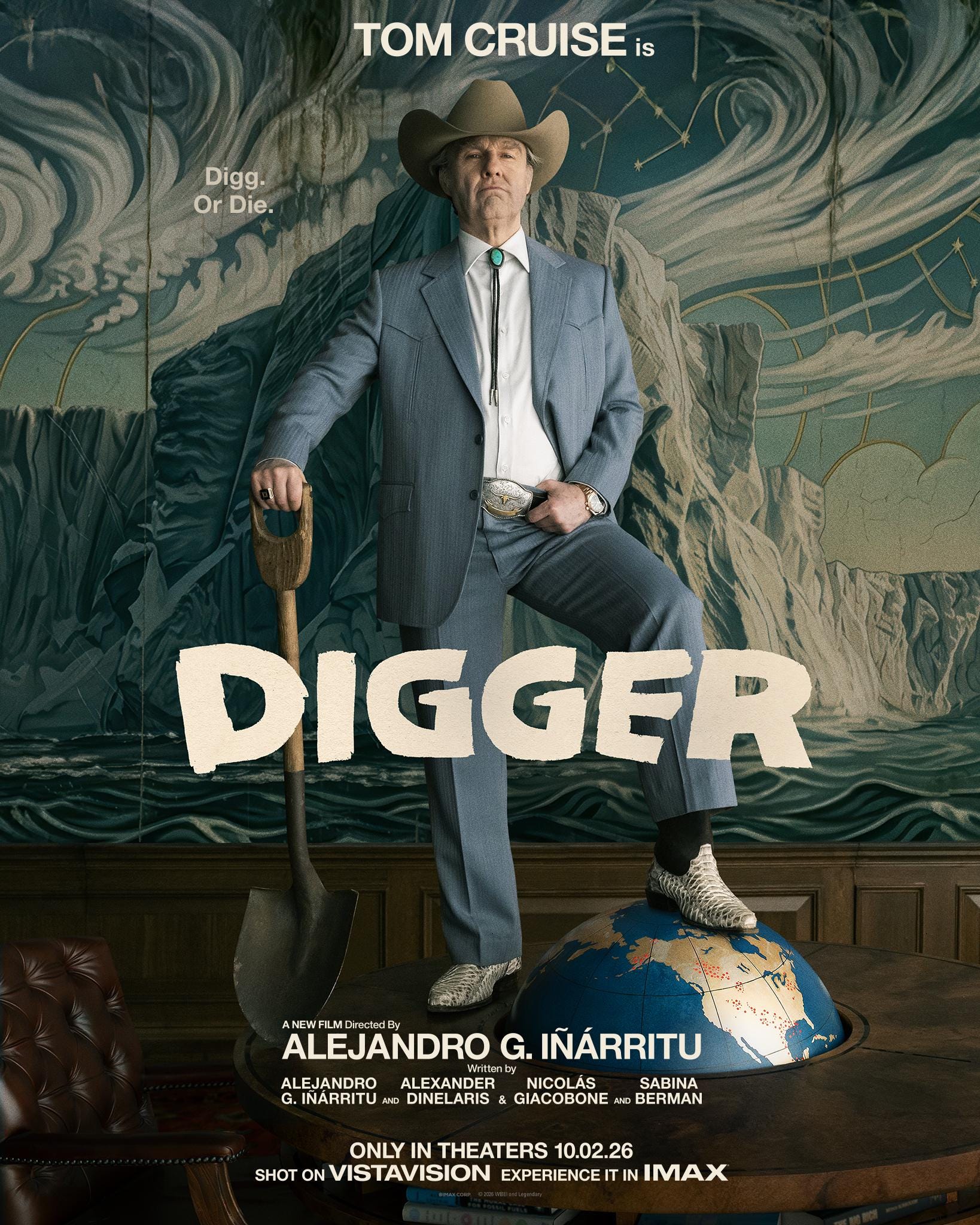
Tom Cruise and Alejandro Iñárritu’s latest movie, Digger, was initially presented as a morality tale about old White men wrecking the world through climate change. After hearing of a twist in the movie and seeing some positive reviews from unexpected sources, I concluded this must just be the surface-level presentation, with the real target being the smug, Don’t Look Up-style sermonising of Hollywood itself. If anyone might hit back against Hollywood liberal groupthink, it would be Tom Cruise, right? And surely, in the age of Big Tech, data centre and AI safety concerns, they wouldn’t seriously do something as clichéd as make the antagonist yet another oil baron, a trope well worn by films like There Will Be Blood, The World Is Not Enough, and even The Muppets.
Thus, I decided to give Digger a chance. As it turns out, the film isn’t just an indictment of the old White Christian men who are ruining the world. It also turns this familiar Hollywood sermon into a self-important meditation on the limitations of satire itself, suggesting that audiences are too easily satisfied with condemning convenient villains rather than confronting any of the problems they represent.
Cruise plays Digger Rockwell, the richest man in the world and a Texas oil tycoon whose name gives you some idea of the subtlety of what follows. When an explosion at one of his Arctic drilling operations sends a colossal chunk of Greenland’s ice shelf drifting towards Europe, threatening millions of lives, Digger is initially more concerned with his dying pet cat than the impending catastrophe. He is soon joined by an assortment of equally grotesque caricatures, including a buffoonish American president and a political establishment populated by stodgy White Christian nationalists.
To give you a taste of the film’s “comedy,” only one joke drew an audible laugh from anyone at the screening I attended. It came when the President, played by John Goodman, admonished one of his generals for swearing because there were ladies present, which prompted his entire entourage of old White guys to bellow with laughter at the idea of including women in such important decisions. The same entourage then ridicules the sensible Indian scientist over his origins when he dismisses the generals’ sole idea of nuking the ice shelf before it reaches Europe.
Still, I held out hope. Perhaps the clichéd political messaging and cartoonishly evil characters were all part of an elaborate joke at the expense of Hollywood’s own political conventions. And then came the “twist,” which isn’t really much of a twist at all, arriving about twenty minutes into the film and quickly becoming central to its narrative. We learn that everything we have been watching is actually a rehearsal for Fossil Fools, a stage play shown decades after the environmental catastrophe it depicts. Cruise is not Digger Rockwell himself, but the actor portraying him for an audience living in the ruins of the world he helped destroy. The exaggerated performances and one-dimensional characters we’ve been looking at are all part of this production, though the events and people they depict were real.
Here, at last, I thought, was where Iñárritu would deliver a more profound critique of the simplistic morality tales sold to us by out-of-touch elites. But no, instead the morality tale remains exactly the same, with this supposedly clever device used only to expand the circle of people deserving indictment and make some pseudo-profound meditations on the limits of satire. The public, we are told, was happy to enjoy the comforts of industrial civilisation while turning a blind eye to the destruction that made them possible. Having allowed the catastrophe to happen, they now seek absolution in the spectacle of condemning the men responsible for it.
In case this message wasn’t clear enough, we get a lengthy monologue where Cruise as Rockwell owns up to the catastrophe he has wrought in front of EU technocrats, only to address the viewing audience directly, telling them (or us) they are as guilty as he is, for regardless of what they preach, they continue to choose the creature comforts of industrial civilisation over safeguarding Mother Nature.


Scenes depicting Digger Rockwell’s desperate attempts to escape responsibility for the catastrophe alternate with a series of uninteresting and underdeveloped backstage subplots. Cruise’s character outside the play becomes preoccupied with news that his daughter’s flight has gone missing during a hurricane, while also clashing with the production’s girlboss director. Neither storyline is particularly interesting, and there’s no reason to care about the characters involved anyway.
Another of the film’s supposedly clever meta moments comes when Cruise, playing the stage actor, interrupts a rehearsal of Fossil Fools, objecting that the characters in the play have become too much like caricature. The real Rockwell, he points out, was a cold and cunning sociopath, not the buffoonish man he is asked to portray. He asks the director if they are making genuine satire or a comedic farce.
At this point, the production’s financier, who we learn is none other than Digger Rockwell’s own nephew, steps in and delivers a monologue dismissing the distinction, insisting that it doesn’t matter what the play is really doing, only that people enjoy it and that it distracts them from their awful circumstances. There’s probably some intended message here about capitalist elites absorbing criticism of themselves and selling it back to us, but rather than exploring its implications, the film presents both this revelation and Cruise’s critique of the production as though their cleverness should speak for itself. With so much of this movie, you get the feeling Iñárritu is delighting behind the camera at the brilliance of his own satire, mistaking the mere recognition of an irony for a profound insight into the workings of the world.
When Fossil Fools ends, we see the post-apocalyptic audience put on their gas masks and leave the theatre for a dystopian world devastated by environmental catastrophe. The message is hardly subtle. Having allowed the world to be destroyed, humanity now contents itself with watching theatrical recreations of the disaster, enjoying the satisfaction of condemning its perpetrators without having to confront its own responsibility. In case there was any doubt the audience is meant to be you, the viewer, we get a similar evacuation notice at the very end of the film’s credits.
But what exactly are we supposed to take from this? That everyone watching is just as prone to being shepherded by malicious elites as these people are? That we shouldn’t be content with merely condemning convenient caricatures of the people wrecking our planet, and should face up to our own role in facilitating them? Or, given that the play is still owned by a member of the Rockwell dynasty, that even our attempts to challenge the powerful are ultimately absorbed and commodified by the very elites we imagine ourselves opposing?
If so, these are remarkably banal and tired observations for a film so obviously convinced of its own profundity. Perhaps some of it would have landed if the film had dared to satirise an accurate version of the contemporary elite consensus rather than Bush-era business Republicans. Instead, we have one of the world’s best-paid actors, backed by Warner Bros. (now part of Larry Ellison’s media empire), delivering An Inconvenient Truth against the evils of our White Christian elites.
What makes Digger especially disappointing is that the premise of satirising political satire has the makings of a brilliant film. Lure audiences in with what looks like another spoof of Trumpism, American militaristic jingoism and greed-is-good neoliberalism, only to reveal these familiar caricatures as comforting schlock for educated progressives to pat themselves on the back without gaining any real insight into the workings of the world.
But making that film would require more than simply reproducing the clichés of conventional satire and then drawing attention to them. It would require some genuine insight on the part of the filmmaker into the relationship between art, power and public opinion that the original satire lacked. It would also require some willingness to question the film’s own assumptions about who holds power and why. But in Digger, it really was the greedy oil baron, the Christian Republican president and his flag-waving generals who brought about the apocalypse. If the stage play is identifying the real culprits responsible for the end of the world, then who cares if its portrayal of them is a little one-dimensional? This is the biggest problem with Digger as a concept: it ridicules the simplicity of its own morality play while leaving its underlying moral assumptions entirely intact.
Beyond this moralising, Digger seems to be asking whether satire is even possible in a world supposedly as terrible as ours. When the film opened to dismal box-office numbers, some commentators suggested its failure was a sign that political satire had become a dead genre in an age of hyper-irony, relentless online mockery and political realities that increasingly resemble parody. But Digger’s failure is hardly evidence that satire is dead. All it actually demonstrates is Iñárritu’s inability to make good satire. His jokes aren’t funny, his characters aren’t interesting, and his political messaging has the profundity of a Greta Thunberg lecture. Having his film acknowledge these shortcomings doesn’t somehow transform them into artistic virtues.
★☆☆☆☆
Thanks for reading. If you enjoy my writing, check out my new book, The Gnostic Question:
The Gnostic Question

I am delighted to announce the release of The Gnostic Question, a book I have co-authored with Richard Storey.