

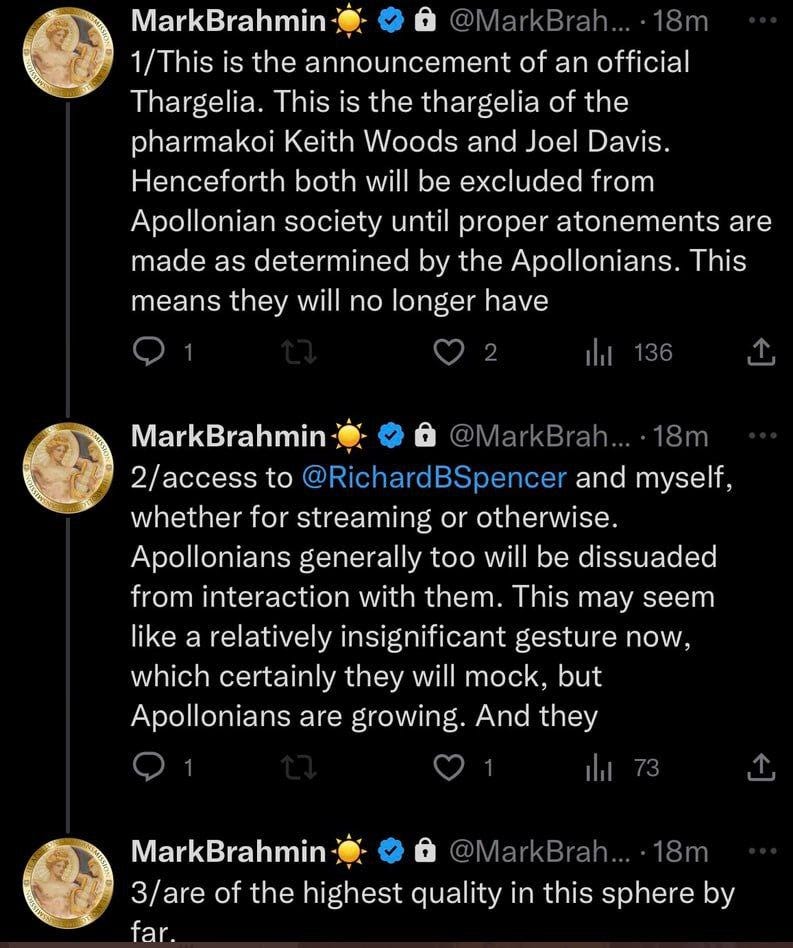
I must start this review with a disclaimer. I remain under an official Thargelia from the Apolloist movement by decree of Mark Brahmin, and the following words are the product of a pharmakos mind. Apolloists reading may wish to end the review here.
Losing My Religion
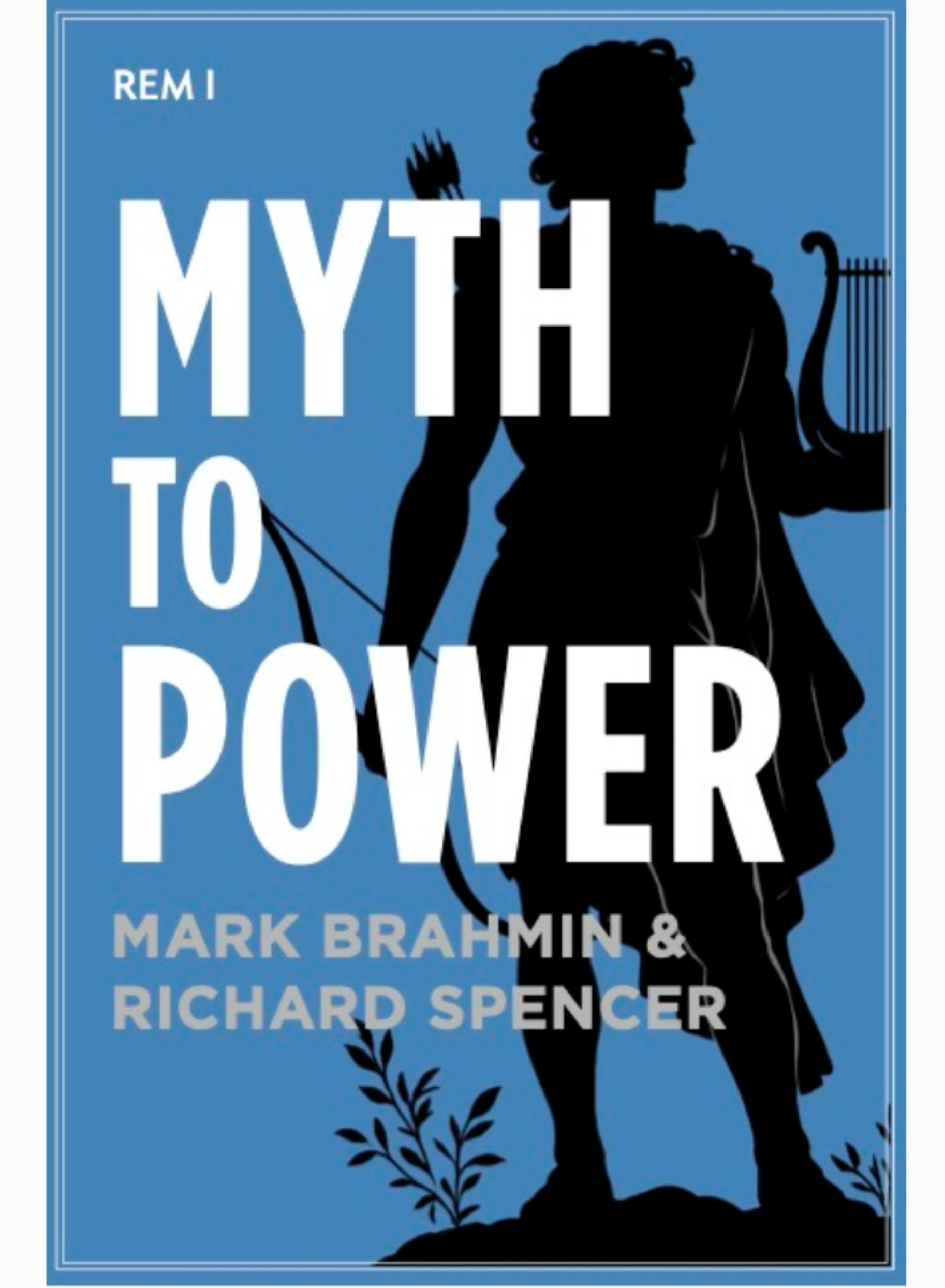
Richard Spencer and Mark Brahmin’s Myth to Power is the long-awaited systematic presentation of their theory of Racial Esoteric Moralization, or REM. This would be the first book Richard Spencer authored or co-authored, though it appears the bulk of the material is essays Brahmin has published on his Apollonian Transmission blog over the past decade.
The theory begins with a simple proposition: people imitate what they admire. From there it rapidly expands into something much more ambitious. Stories are said to establish ideals of conduct and attraction, those ideals influence mating, and mating shapes the population. “Myth and ethos direct breeding.” The artist therefore becomes, in effect, a racial engineer.
The book aims to use the power of REM to uncover a hidden system through which Jewish and “proto-Jewish” priests, artists and storytellers have consciously shaped populations for thousands of years, ultimately even directing their biological development. The reader learns that what we ordinarily separate into religion, myth, propaganda and entertainment is actually one continuous technology of racially conscious social engineering.
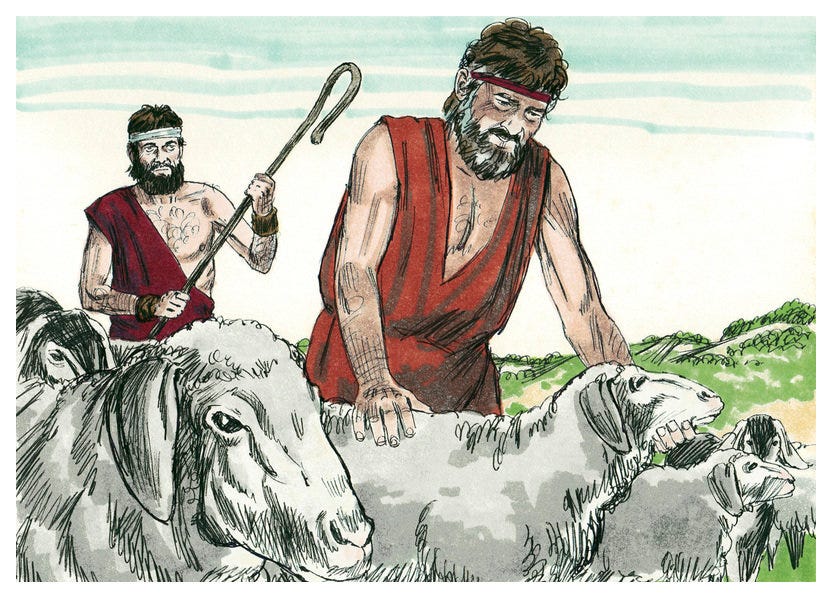
The foundational example is Genesis 30. Jacob places striped branches before Laban’s sheep while they mate, after which they produce streaked and speckled offspring. Spencer and Brahmin take this story to be an allegory of cultural control over reproduction. Since Laban’s name means “white,” they identify his flock with a white population, the speckled animals with racial mixture, and the branches placed before the sheep with the cultural environment shaping human mating. “Whatever holds the attention and forms the cultural milieu,” they conclude, “governs human behavior and breeding.”
These meanings are produced by the authors moving from the meaning of Laban’s name, to the familiar metaphor of humans as sheep, to the assumption that variation in coat colour represents human racial difference, and finally to the claim that what the sheep see represents the cultural environment. By the end of the chain, an ancient story about Jacob manipulating livestock has become evidence that its authors possessed a theory of mass media, sexual selection and racial engineering. Even the most basic step is already extremely questionable: that an ancient Hebrew author would associate the colour white with a European racial classification.
This interpretation supplies the template for the entire book (it was also the subject of a debate between Mark Brahmin and Jay Dyer, which I encourage readers to listen to, because it’s one of the funniest ever pieces of internet history). REM is divided into JEM, Jewish Esoteric Moralization, and AIM, Aryan Inner Moralization. JEM supposedly consists of myths and symbols designed to advance Jewish or “Proto-Jewish” interests; AIM is the rival system the authors want to construct for Aryans. The practical purpose of the project is to lay a foundation so that works that “have an AIM” may be developed and eventually treated as sacred. Myth to Power is therefore both an attempt to decode an alleged propaganda system and a manifesto for building another one. Volume 1 focuses on the first part of the project.
Trying to start their own religion online requires Spencer and Brahmin to take a very strong position on the origins of religion itself. They dismiss as “absurd” the idea that the Greeks and Romans were genuinely superstitious and argue that their educated elites understood the gods essentially as myths and concepts rather than real beings. “The first man to speak the name of these gods,” they claim, must have understood the deity as his own invention. This is doing enormous work for REM. If important gods and myths were consciously invented from the beginning, then ancient religion can plausibly be treated as deliberate social technology. But no evidence is presented for even one instance of this. The authors are simply projecting their own modern rationalist incredulity backwards when they insist that intelligent ancient peoples could not sincerely have been “superstitious.” The conscious engineering of ancient religion is crucial to the entire thesis of the book, yet it is simply assumed at the outset and then used as the basis for interpreting particular myths.


But there is little in the historical record to support this imagined divide between educated, rationalist elites and superstitious commoners. Pliny the Elder’s Natural History, one of the great encyclopaedic works of Roman learning, records remedies such as stopping hiccups by touching a mule’s nostrils with one’s lips; Plutarch reports that the great toe of Pyrrhus possessed healing powers and miraculously survived his cremation. Spencer and Brahmin contrast the supposedly sober educated elite with the superstition of the masses, yet beliefs of this kind permeate the works of antiquity’s most learned authors. Livy records the Senate ordering sacrifices and public prayers after reports of prodigies including a speaking ox, a two-headed pig and a sweating altar. Perhaps I will be accused of missing the AIM in these stories, but it seems to me that the ancients were perfectly capable of extraordinary intelligence and extraordinary superstition at the same time.
Another major difficulty is that “Proto-Jewish” is defined so loosely that it can absorb vast stretches of ancient civilisation. Spencer and Brahmin use the term for an alleged myth-bearing priestly class, present since Sumer, whose cults and symbols eventually developed into Judaism through a “continuity of initiates.” These Proto-Jews need not even have been ethnically Semitic;. The category can encompass the cultural elites of any society the authors place within the relevant symbolic tradition. This allows them to find Proto-Jews among groups like the Etruscans, Spartans and Zoroastrian Magi, and in cults stretching from Sumer and Egypt to the Greco-Roman world. Vulcan, Bacchus, Mercury, Saturn and Pluto are all folded into the same genealogy, which supposedly survives through Judaism and Christianity before reappearing in modern popular culture.
As good Nietzscheans, the authors have a particular bone to pick with Plato and Socrates. Plato’s doctrine of the immortal soul, they argue, was “in no way Aryan,” but was instead drawn from “chthonic, Proto-Jewish Mystery and personal-salvation cults.” Elsewhere they simply refer to him as “the proto-Jewish Plato.” The Orphic and Pythagorean traditions that influenced him are thereby incorporated into the same esoteric lineage that eventually produces Judaism and Christianity. Here, as with much else in the book, the reasoning is largely circular. Bacchus is classified as Proto-Jewish, so Orphism becomes Proto-Jewish because it centres on Bacchus. Pythagoreanism is Proto-Jewish because it inherits Orphic ideas, and so Plato is Proto-Jewish because he inherits Pythagorean ones.
This demonstrates a broader problem with Myth to Power: the book repeatedly moves from evidence of influence or resemblance to much stronger claims about the identity and intentions of those responsible for it. That stories influence people, symbols recur and artists borrow from earlier traditions is obvious enough. But these observations are repeatedly made to support claims of extraordinary historical specificity: similarities become evidence of a particular line of transmission, and transmission is then taken to imply participation in a single esoteric programme serving a racial strategy. At every stage, the claim becomes more extraordinary while the standard of evidence gets weaker.
So how can REM distinguish a real esoteric pattern from one generated by the interpreter? The book’s answer is that you will know it in your heart if your interpretation is correct, because successfully decoding REM gives one the feeling of solving a riddle:
REM carries with it plausible deniability. Indeed, the living Jewish artists whose work we explore in this study would likely vigorously deny almost all of our interpretations, if ever they were presented to them. Yet the reader will find our interpretations accurate and corroborated. Indeed, the sensation of solving REM messaging is often like the sensation of solving a riddle. One knows immediately that one is correct and not 'reaching.'
At this point, we’ve reached Candace Owens epistemology: the authors don’t know know, but they know.

The End of Critical History as We Know It
The book’s treatment of the Irish Túatha Dé Danann provides the best example of the flaws of REM once it is applied to an actual body of mythology. The argument begins with a genuine feature of the surviving Irish material: much of it was recorded by Christian monks, and biblical genealogies were sometimes grafted onto native traditions. From this uncontroversial observation, Spencer and Brahmin proceed towards the possibility that some of Ireland’s most famous pagan gods are actually representations of Jews.
The first clue is the name. Túatha Dé Danann is normally rendered as the people or tribe of the goddess Danu. The authors argue it is more likely “Danann” is connected with the biblical Tribe of Dan. The evidence for this is the similarity of “Danann” and “Dan.” This becomes more suggestive because Dan is described in Genesis as “a serpent in the way, a viper by the path,” and the book has already claimed the serpent as an established Proto-Jewish symbol. Thus, Dan becomes a “Crypto-Jewish archetype” associated with concealment and striking from behind. At this point even characters called Dan, Danny or Dani in The Shining, The Karate Kid and Midsommar are identified as Jewish-coded.
The authors regard an older Irish term as even more decisive. Túath Dé, which could mean “tribe of the gods” or “tribe of God,” was used in medieval Irish writing both for the pagan divine race and for the Israelites. From this linguistic overlap they ask whether Túatha Dé Danann might actually be a literary reference to the Israelite Tribe of Dan. Eventually the authors are prepared to ask whether modern Celtic neopagans might unknowingly be “worshiping Jews—albeit through an esoteric text.”
We then get a list of other apparent connections. The Túatha Dé Danann arrive in Ireland amid mist and are repeatedly associated with fog and magical clouds. Yahweh also appears in clouds in the Hebrew Bible, so the mist is likely another indication of their Jewish identity. Their four legendary cities and four magical treasures can be related to the four elements, Platonic-Pythagorean symbolism and ultimately the four camps into which the tribes of Israel are arranged in Numbers. Within REM, even having four of something can become evidence of a biblical Jewish genealogy.
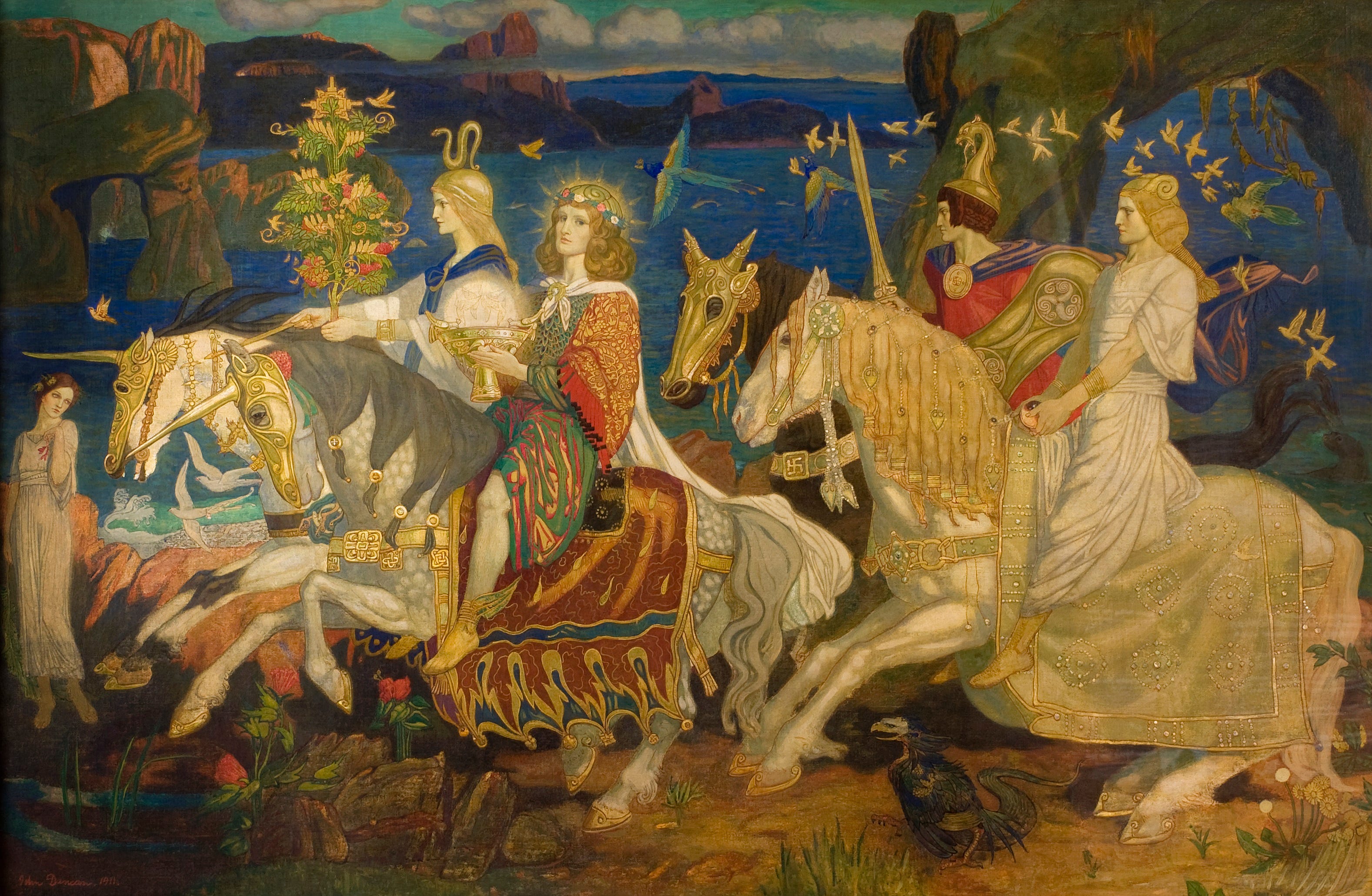
None of these individual examples is particularly convincing and there is no argument provided to connect them other than resemblance. Danann resembles Dan; Dan is a serpent; serpents are already Proto-Jewish; Túath Dé can mean “tribe of God”; the same expression was used for Israelites; the supernatural race lives amid clouds; Yahweh appears in clouds. Each association supposedly reinforces the others, even though none establishes that the medieval authors intended the identification in the first place.
Spencer and Brahmin then ask how this alleged Jewish material reached Ireland. One possibility is transmission by Phoenician traders in the Bronze Age. Another is Pythagorean influence upon the Druids, with Pythagoreanism itself having already been classified as Proto-Jewish. A third, which they call the most compelling, is that Celtic mythology was substantially created by crypto-Jewish pagan bards and Christian monks practising JEM. The Druids themselves may even have contained crypto-Jews or have constituted a “consciously Jewish-formed sect.” Crucially, we are told that these possibilities do not exclude one another.
The same move is then applied to Norse mythology: because much of the surviving material was recorded by Christian writers, Christian influence is expanded into a theory of crypto-Jewish authorship. The authors accordingly classify Odinism among the same suspect religious traditions and suggest that the “pith” of Norse mythology may itself be Christian or crypto-Jewish.
Here the argument runs into a more basic historical problem. Spencer and Brahmin repeatedly lean on the fact that the surviving Eddas were written down by Christian authors in the thirteenth century. But the date of a surviving manuscript is not the date at which the traditions it records were invented, which the authors immediately concede when they write that the poetic Edda drew "upon older works from the tenth."
There is of course evidence for Germanic religion centuries before it was documented by Christian writers, including Tacitus’ much earlier descriptions of Germanic cults. Again, as with the Túatha story, it is hardly controversial to conclude that Christian monks reshaped pagan material, but that does not license the massive jump Spencer and Brahmin take to claiming they created its underlying mythology as a crypto-Jewish system of racial manipulation.
The bizarre logic of the method should now be apparent. Ordinarily, rival historical hypotheses are supposed to compete: evidence that strengthens one route of transmission may weaken another. Here, every possible route expands the theory. If the symbols entered Celtic mythology in antiquity, Proto-Jewish Pythagoreans may have transmitted them. If they entered much later, crypto-Jewish monks may have inserted them. If neither can be demonstrated, Phoenician transmission remains available. The authors never have to establish who transmitted a myth or what their intention was, because transmission can be inferred from the symbols themselves. By the end of the exercise, an uncertain etymology and the mundane fact that Norse texts were preserved by Christians have become grounds for hypothesising millennia-long Jewish esoteric influence on Irish and Norse mythology. Phoenicians, Pythagoreans, crypto-Jewish Druids and Christian monks can all perform the same explanatory function. The same method becomes considerably more entertaining when applied to modern popular culture.
Shiny Happy Gentiles
Once the method has been established, the examples hardly need much commentary. The authors machine-gun the reader with cases of JEM in modern cinema.
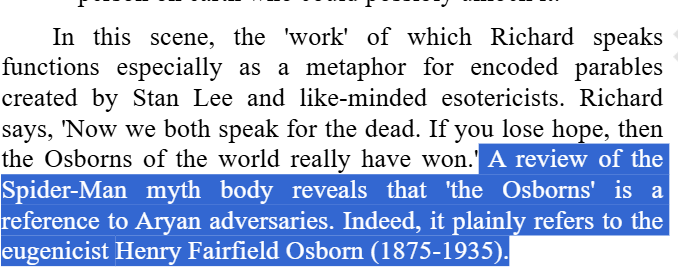
We are told that Spider-Man’s enemies the Osborns “plainly” refer to the 19th-century eugenicist Henry Fairfield Osborn, whose birth year they get wrong by 18 years. The entirety of the evidence for this is the shared surname.
Spider-Man’s Aunt May “appears to be a reference” to Maia, the mother of Mercury.
Ant-Man is Hank Pym. A pym, the authors inform us, is an ancient unit of wealth worth two-thirds of a shekel. Here they are more modest in only speculating that an esoteric allusion to a Jewish currency denomination is the basis for the character’s name.
More confidently asserted is that Ant-Man’s Jewish partner transforms into the Wasp to fit into WASP (GET IT??) society:
Stan Lee’s 'Ant-man,' too, must don a helmet to shrink to an undetectable size and doubtlessly this parable deals with themes of crypsis as well. His consort, 'the Wasp,' who appears coded a Jewess with a Gentile father and surname, literally becomes a WASP to fit in.
Spider-Man villain Kraven the Hunter is “almost certainly” Nimrod, because Nimrod was also a “mighty hunter.” His Russianness may additionally be an ethnic attack on Russians as “not quite” European.

Daredevil’s law partner Foggy Nelson is Yahweh. “Foggy” evokes fog, fog evokes clouds, and Yahweh repeatedly appears in clouds in the Hebrew Bible. Nelson is then rendered as “Son of Cloud.” Foggy/Yahweh controls the Christian Daredevil, whose blindness is a representation of Gentile obliviousness.
Stan Lee seems to present 'Daredevil’s' senior law partner, 'Foggy' Nelson ('Son of Cloud'), as a Yahweh figure, implicitly directing and controlling the blind, Christian, Gentile-coded Daredevil. Here, his blindness doubtlessly refers to a 'spiritual blindness' or Gentile obliviousness.
John Connor’s initials are JC, making him Jesus Christ. Sarah Connor is Mary. Kyle Reese is Yahweh or Gabriel. Schwarzenegger‘s Austrian heritage completes the puzzle: he is literally Hitler. The film is therefore “the battle between Jesus and Hitler for the future of the world!”
Interestingly, the robot of the first film, the T-800 Model, is played by Arnold Schwarzenegger. Why would a ruthless AI create an 'infiltration unit' with such a conspicuously Austrian accent? Whether intentional or not, the casting decision sets up the central conflict of the film—the battle between Jesus and Hitler for the future of the world!
Why is the artificial intelligence called Skynet? Because “sky” evokes the Proto-Indo-European Sky Father. The Schwarzenegger Terminators then resemble muscular Olympian gods. Their glowing red eyes may refer to HAL 9000, whose eye may itself represent the sun.
Once again, there is an awkward problem with this interpretation that can be discovered by a Google search. James Cameron originally conceived the Terminator as a physically nondescript infiltration unit who could disappear into a crowd, a conception that was later revived with Robert Patrick’s T-1000 in Terminator 2. The not-so-Aryan O.J. Simpson was originally the first choice for the role of the Terminator, with Cameron and the studio actually earmarking Schwarzenegger for the role of Kyle Reese.
During their meeting, however, Schwarzenegger gave Cameron such a meticulous account of how a machine assassin should move that Cameron became convinced he should play the Terminator instead. The supposedly meaningful Austrian superman at the centre of the REM interpretation was therefore not part of the character’s original conception at all, but the contingent result of a casting decision. I wonder if Schwarzenegger’s turn to protagonist in the sequels reflects James Cameron’s later embrace of AIM.
We continue. In The Empire Strikes Back, Luke Skywalker loses his hand. This is “not simply a metaphor of castration,” but may also signify his sexual defeat by the “possibly Semitic” Han Solo in their competition for Leia. Leia can then become Luke’s “racial sister,” while Han is compared with Orion competing for Diana.
Daenerys Targaryen has dragons. Dragons have already been placed within the Semitic symbolic system alongside serpents, Satan and Bacchus. She is therefore Jewish-coded, despite looking rather inconveniently Aryan. But wait! Though she may look Aryan, her hair is not merely silver, but “lunar silver.”
The modern Aryan scarcely bats an eye when she emerges as the heroine. 'Neat,' he thinks. 'And look how blonde an Aryan she is!' Yet her symbols, as well as her fugitive backstory, are those of the antagonistic 'anti-Westeros.' In other words, despite her hair, she is coded Jewish. And notably, her hair is a lunar silver in the books.
I bet even veteran racial esoteric moralists would have missed that detail.


The black monolith in 2001: A Space Odyssey is a black stone. Black stones evoke Saturn; Saturn is connected to Jewish symbolism; Yahweh is repeatedly described as a rock. The monolith is therefore, “most prominently,” Yahweh. It is also Saturn, Mercury and Prometheus.
While most of the analysis is confined to Western culture, Spencer and Brahmin take a detour to compare Hollywood’s decline to Hindu India, informing us that Shiva is “the Indian Bacchus,” and his cult was “doubtlessly” Jewish in origin:
The decline we see in Hollywood is far from unique in the history of religio-cultural development but seems instead the standard. Very likely a similar process took place in Hindu India, at least after the ascent of Shiva, the Indian Bacchus, during the first to fourth century AD. Doubtlessly his cult, among others, including much earlier ones, was either an offshoot of Judiasm, common Proto-Jewish cults or was, simply, crypto-Jewish.
These are just some of the book’s more dubious applications of REM to popular culture. The examples continue at exhausting length, before the authors themselves then provide the perfect summary:
The world revolves around REM.
And of course, for the authors it does: a theory this expansive, and this indifferent to empirical constraints, can pull anything into its orbit.
A Thargelia Against the Copy Editor
Even on its own terms, the book does not apply its categories consistently. Michelangelo’s David is introduced as “a new incursion of de-facto AIM” and then, almost immediately, “correctly classed as shoal-culture,” without explaining how the two classifications relate. The categories are elastic enough not only to absorb contradictory evidence, but to assign opposite classifications to the same work, within the same paragraph.
The problem is compounded by the sheer number of ordinary factual, chronological and editorial errors throughout the book. Films are given the wrong release year; the Roman theologian Cornelius Labeo is placed in the wrong century; biblical verses are mis-cited (“Revelation 5:28–29” is cited, despite Revelation 5 having only fourteen verses) and relatively elementary historical and linguistic claims are stated incorrectly. The manuscript is also riddled with ordinary typographical errors and malformed sentences. There are dozens of spelling errors, and sentences such as “Thus neither was their a knower who could create” and “Christopher Nolan... the Stanley Kubrick remains the master.” The endnote numbering also inexplicably restarts between some chapters but not others.
I know from first-hand experience that self-publishing is difficult and that minor typographical errors can easily slip through the editing process, and I would normally give a lot of leeway to issues like this. But this is a book that two authors and their intellectual circle have been working on for almost a decade. And it would still matter less for any other book, but Myth to Power depends on tiny details around dates, names and spellings carrying enormous interpretive weight. When a book asks you to believe that a single misplaced vowel conceals five millennia of racial engineering, it had better not mistake the third century AD for the third century BC.

Everything is REM
The problem is not ultimately that the book makes a lot of dubious interpretations or gets some facts wrong. It is that this interpretive flexibility is built into REM itself. Spencer and Brahmin have built in a means of absorbing almost every possible state of affairs into JEM: conscious deployment of the symbols counts, but so does unconscious transmission; a Jewish creator fits the theory, but non-Jewish creators and Jews who don’t know about JEM can yet produce “de facto JEM” by participating in a cultural milieu already shaped by JEM. When I challenged Brahmin’s theories in the past, I was accused of being a “crypto-Christian,” whatever that means.
The book also warns of “Post-Jews,” apparent gentiles whose identity cannot be established by ordinary means and who will therefore have to be identified through the symbolic patterns REM purports to decode. The interpretation can thus establish the hidden identity of an author, while that hidden identity can subsequently corroborate the interpretation. We also learn of the “Sussman,” a Jew who reproduces JEM without understanding its true esoteric purpose. The absence of evidence that a particular artist consciously understands JEM therefore presents no great difficulty: he may simply be transmitting it without knowing what he is doing.
But Spencer and Brahmin need to identify at least some people who consciously propagate JEM for their theory to make sense. They explicitly identify some of the most prominent filmmakers of the twentieth and twenty-first centuries, as well as every major Jewish comic-book writer of the period they survey, as “masters” of JEM:
Some of the most prominent writer-directors of the twentieth and twenty-first centuries are masters of JEM: Woody Allen, Ari Aster, Darren Aronofsky, Joel and Ethan Coen, Mark Kamen, Stanley Kubrick, David Mamet, Sam Mendes, Roman Polanski, Steven Spielberg, Robert Towne, Billy Wilder, and Lana and Lilly Wachowski. Writers Ira Levin (Rosemary’s Baby (1967)) and Bernard Malamud (The Natural (1952)) deployed JEM in their novels in striking ways. More recently, J.J Abrams (Star Wars (2015-19)); Michael Green (Blade Runner 2049 (2017)); John Hamburg and Jim Herzfeld (Meet the Parents (2000)); Charlie Kaufman (Eternal Sunshine of the Spotless Mind (2004)); writer and director Gil Kenan and Jason Reitman (Ghostbusters: Frozen Empire (2024)); and Boaz Yakin and Ed Solomon (Now You See Me (2013)) are also practitioners of JEM. A close review of Marvel and DC comics from 1938 through 1966 and beyond reveals that every single major Jewish comic-book writer, from Stan Lee to Jerry Siegel to Bill Finger, practiced JEM. This includes lesser known figures like John Broome, Chris Claremont, Robert Kanigher, David Michelinie, Julius Schwartz, and Marv Wolfman. JEM’s prevalence in pop culture—and thus the public’s imagination—cannot be underestimated.
It is here that we really see how gigantic the gap in evidence is for this theory. Surely once the theory moves from unconscious cultural transmission to claims about conscious practitioners of an esoteric tradition, we should expect some evidence that the alleged practitioners actually understood the symbolic system in anything like the terms Spencer and Brahmin reconstruct. Yet the book offers nothing. We know the practitioners have mastered JEM because Spencer and Brahmin think they see esoteric codes in their productions, and their supposed participation in JEM is then used to corroborate the decoding. No Country For Old Men must be full of JEM because it’s made by the Coen brothers, and we know the Coen brothers are master manipulators of JEM because Mark Brahmin noticed esoteric JEM symbols (like clouds, the number 4, and the name Daniel) in their films.
Early in the book, the authors cite Kevin MacDonald’s The Culture of Critique approvingly, and clearly see REM as engaged in a similar exercise: uncovering a hidden “group evolutionary strategy” among prominent Jewish cultural producers, much as MacDonald attempted to do among twentieth-century Jewish intellectuals. But bringing up MacDonald only highlights the profound methodological difference between a serious scholar and a conspiracist blogger.
MacDonald understood that attributing conscious group interests to particular individuals created a great documentary burden on him. He therefore went looking through biographies, correspondence and records of private conversations for evidence that the intellectuals he studied understood their activities in terms of Jewish identity and Jewish interests. I recall long sections of his book stacking biographical detail on figures like Franz Boas to establish that Jewish identity and concern about antisemitism were important in his personal life, and then arguing, again through extensive biographical detail, that these commitments helped shape his political outlook and academic work. Now imagine if MacDonald had identified a few dozen Jewish intellectuals as conscious masters of an esoteric Jewish group strategy, then posited as his sole evidence that he saw signs of esoteric Jewish subversion in their work. The authors of Myth to Power intimate in the introduction that they have each been frustrated by academia and decided to undertake this research free of the confines of the modern academy. It seems what they are really demanding freedom from is even the most basic evidentiary standards of historical inquiry.
This evasion of evidentiary standards appears throughout the book. As demonstrated by the jump from Christian handling of pagan sources to a claim of Christian authorship, the authors’ greatest claims constantly fall back on a kind of motte-and-bailey argument, in which a relatively uncontroversial proposition is affirmed and then treated as evidence for a much stronger one.
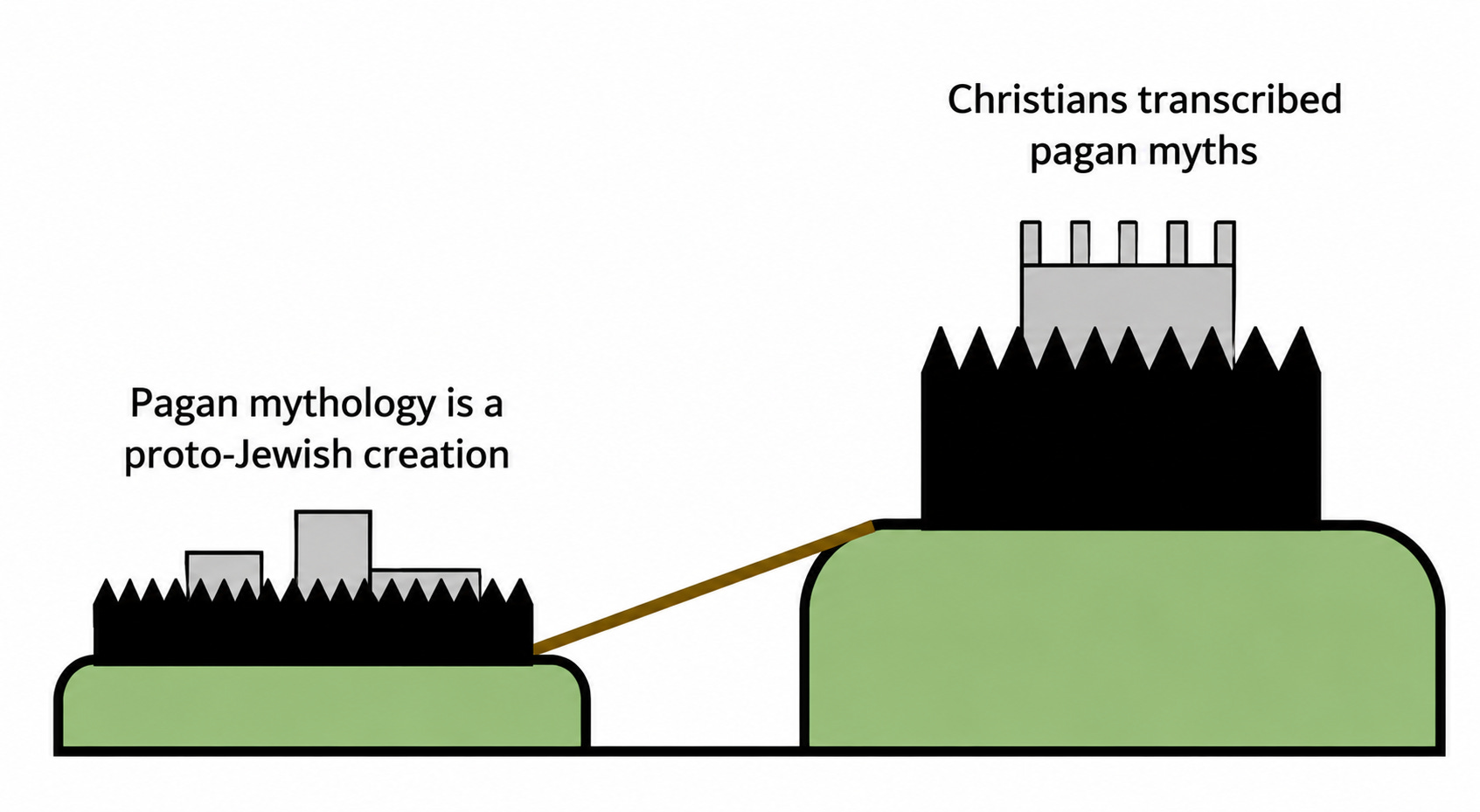
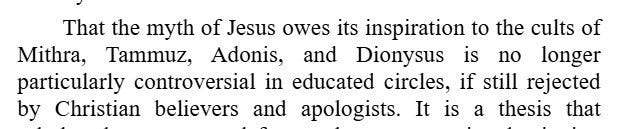
The same manoeuvre appears in the book’s brief declaration of victory for Christ mythicism. Spencer and Brahmin say that Christ mythicism is “evidently correct,” tell us it is “no longer particularly controversial in educated circles,” and later announce that “Mythicism, to some degree or another, has prevailed.”
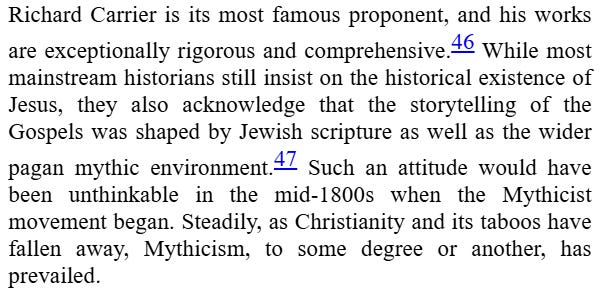
Yet in the very same discussion they concede that “most mainstream historians still insist on the historical existence of Jesus,” but point out that the same scholars accept the much weaker claim that the Gospel narratives were shaped by Jewish scripture and the broader religious environment of antiquity. But that fact is perfectly compatible with a historical Jesus and is not Christ mythicism. In fact, the scholar they cite in support of this point is Bart Ehrman, one of the most outspoken critics of Christ mythicism. Nevertheless, acceptance of the weaker proposition is presented as evidence that the stronger Mythicism thesis has somehow prevailed.

More fundamental than any dispute over whether a particular character or symbol has been correctly decoded, however, is whether REM’s supposed mechanism has ever been demonstrated at all. Remember that the theory does not merely propose that art influences attitudes or that stories provide moral and aesthetic ideals. Those propositions are banal. REM claims that cultural production can alter sexual preferences and mating behaviour sufficiently to redirect the biological development of entire races. Yet the book offers practically no empirical evidence that this mechanism operates on anything like the scale required, let alone that its effects can be detected in historical population dynamics. Instead, we are returned to their idiosyncratic reading of Jacob’s sheep and to symbolic interpretations of works of art.
A serious historical theory has to expose itself to the possibility of failure. There must be some imaginable discovery capable of forcing its proponents to abandon or substantially revise a claim. With REM it is difficult to say what such evidence could even look like. Stripped of its elaborate terminology, REM finally amounts to little more than Richard Spencer and Mark Brahmin’s pet conspiracy theory. As with any other conspiracy theory, if no possible evidence can count against REM, then no amount of evidence can meaningfully count for it. Some readers will find these interpretations compelling, but Myth to Power is unlikely to convince anyone not already dazzled by Spencer and Brahmin’s vision.
If you enjoyed this, please subscribe to my free newsletter to get all my future writings.
If you want to financially support my work in the face of recent financial deplatforming, please join the members club, where you can get access to member benefits, including my book Nationalism, the private members’ Telegram, mailbag submissions, and more:
Occam’s razor at its finest. One can recognize Jewish disdain for western people without needing such a grand conspiracy.
The problem here is that these two authors thought they were Nietzsche 2, and could copy his quasi aphoristic style that looks like vibes based association of different ideas and historical facts into a coherent whole, make birth of tragedy 2, and influence generations to come.
The problem: Nietzsche was one of the preeminent authorities on classical Greece even at the young age that he was writing the Birth of Tragedy (which itself is a coherent work with extreme clarity and clear arguments). It's through the thorough understanding of the material that he was able to come up with his analysis and novel ideas.
It's clear that these two have had neither the intellectual capability to be Nietzsche nor did they put in the work to become world-rank scholars to come even close. The result is a desperate attempt to produce something world revolutionary and provocative like Nietzsche, but it ends up a garbled together mess of nonsense.
Some insights aren't even that wrong — as you said it makes sense that for example Jews would be interested in stories of double identity, if you study biographies etc. But you can explain this purely through genealogy and material conditions. Looking the same, yet being different deep down was a structurally common experience for Jews to have. That Jews have an interest in moralising themselves, or their own philosophical ideas they may have gotten from their structural situation in European society, sure, I guess. Elaborating that into a massive conspiracy theory of Jews deliberately putting symbols absolutely everywhere just to put "Aryans" down is completely insane.
This book is and REM in general is a catastrophe for the right because with it the rightis effectively left with nothing philosophically or conceptually concrete to build itself up on that isn't Catholic integralism, which is on very shaky ground itself since the Church is trying hard to kill and excommunicate them. Atheism doesn't seem to be a way forward, as Richard Dawkins himself admitted. "Cultural Christian" is just liberalism. A way out has to be found, and with this Apollonism is completely dead. It had potential; hardcore Pan-Europeanism, anti-thirdworldism, pro-Ukraine, moving beyond Christianity, relatively cool symbols and so on.
It seemed like they were trying to provide the right wing with an idea that went beyond mere Conatus. The right is mostly fixed on something like: "I want to preserve my culture and my people and I don't need anything more than that." That's what Jared Taylor has been doing for 30 years and it's boring, empty, uninspiring. Nobody cares. Mere self preservation isn't a value and and Nietzsche himself realised this. And with the failure of this, I guess, the Western right wing is literally just Conatus or Christianity against Christianity.
I'd be interested to hear what you have to say to this conundrum especially.