



After the worst week in history for plan trusters, allow me to kick a little more sand in their faces.
I think I've always been fairly level-headed about Trump. I was glad to see him win in 2016, disappointed with what followed, but basically accepted the much-maligned “lesser of two evils” case for reelecting him in 2020 and 2024. I am generally opposed to accelerationism, and was never convinced the radical right could muster enough numbers to dictate either election, which I think turned out to be true. Nor am I inclined to tell my American, German or French friends the correct political strategy for them, knowing how embarrassing it can be to watch foreigners pontificate on the minutiae of another country's politics. I was skeptical of, but sympathetic to, the people who wanted to make the best of what MAGA offered.
This reasoning is too lukewarm to satisfy either side of the right-wing Twitter divide, so for years I’ve been called both an unpaid MAGA shill collecting fell-for-it-again awards and a member of the “retard right” congenitally “trooning out” and not trusting the plan — sometimes for the same opinion.
Then, in a grimly predictable turn of events, Trump torched his second term, and perhaps the future of his party, for a war in Iran. At this point, just about everyone with an open mind to the remaining promise of Trumpism realised this was a catastrophic error, denouncing both the war and the Israel-Firsters whom Trump officially appointed as the thought leaders of MAGA.
Everyone, that is, except a collection of unimpressive, mostly millennial shills — I hereby appoint John Doyle an honorary millennial — who spent the intervening months attacking anyone sounding the alarm on their own side, prematurely declaring victory over the Islamic Republic, and confidently predicting a midterm triumph. Then came the blue tsunami, sweeping away the last sandcastles of the plan trusters and provoking some much-belated soul-searching and scapegoating among the battered faithful.
Since then, some of the most prominent trusters have said they’re ready to move on. Scott Greer penned a rueful piece titled Plan Trusting Is Over, sketching the bleak prospects facing any Republicans still attached to the Trump brand:
Yes, many parties have quickly recovered from crippling electoral defeats. Republicans bounced back from 1964 and 2008. Democrats bounced back from 2010 and 2024. But this is a different situation. Even if Trump quickly ends the Iran War on decent terms, the corruption remains. Democrats are going to ensure this issue stands front and center before the public over the next two years. What has been revealed so far about this administration pales in comparison to what will be uncovered in House investigations.
Even the most faithful plan trusters like Fugitive Caesar — who confidently assured me the Iran War had already been won 6 months ago — have realised that the war is, in fact, still happening, and that Trump's rank corruption and neglect of domestic policy are problems.
Matt Forney — MAGA thought leader and author of Big Lovin’: The Guide to Picking Up Fat Chicks and Do the Philippines: How to Make Love with Filipino Girls in the Philippines — is apologising to BAP for getting the war so wrong.
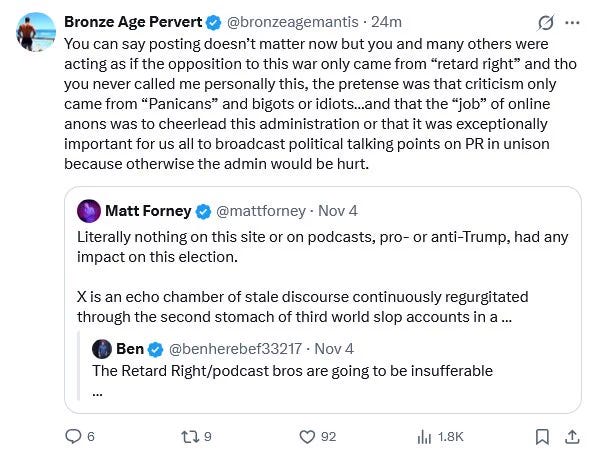
Captive Dreamer and John Doyle, for their part, are pretending they never supported the war and deciding that now, right after the movement’s electoral humiliation, is the right time to stand up to the unpopular agenda of “the neocons” (disclaimer: Doyle says the entire monologue defending the Iran War with neocon talking points requires context.)
Most of these people are not very relevant outside occasional comic relief, but perhaps there are some lessons to be learned here. I can think of two.
First, I’d like to revive my radical suggestion that right-wing political commentators should be honest with their audience. There is nothing inherently wrong with being a partisan political activist, or even remaining a team player when your side does things you disapprove of. But when that loyalty requires you, as a public commentator, to mislead your audience, you have an intolerable conflict of interest. I was stunned by how many of these people effectively told their audiences after the midterms: “Yes, we misled you about the war, Trump's popularity and the abandonment of our political agenda, but now we’re going to get very honest.”
Why would anyone ever listen to someone who strategically lied to them again? What’s worse, these same people insist that the echo chambers of online political discourse matter little to the direction of events, and regularly dismiss the influence of “low-IQ antisemites” like Tucker Carlson, some of whom command audiences of millions. Yet for months they insisted that criticism of Trump from the right served only to demoralise their own side and empower the Democrats. If online commentary is so politically inconsequential, why did they devote so much energy to policing the opinions of their own tiny audiences?
Now, having watched their party suffer a crushing defeat over policies they defended, they have finally discovered the virtues of internal criticism. It seems that many of these commentators, who had little relevance before becoming MAGA cheerleaders, were clinging to their narrative more out of stubbornness and wounded pride than serious conviction.
The second lesson, then, is the danger of audience capture. A strange polarisation has developed on the online right in recent years, with accusations of audience capture becoming a favourite charge against rival factions. Many of the plan trusters have spent years decrying the growing influence of “third worldists” and their supposed pandering to an increasingly non-Western, antisemitic audience. There is something to these complaints. The proliferation of “low-IQ antisemitism”, the increasingly outlandish conspiracy theories promoted by grifters like Candace Owens, and the concessions to leftist ideology made by some newcomers to these ideas are all legitimate subjects of criticism.
But the reaction against these tendencies produced its own absurdities. This took the form of a counter-polemic of semi-ironic philosemitism and Zionism, particularly popular with those seeking to defend Trump's foreign policy. Again, though, the irony is hard to miss: the same people who dismissed anti-Israel voices as irrelevant and claimed to be on the front lines against MIGA and the neocons spent the months leading up to the midterms posting Alex Karp edits and amplifying Mark Levin against Thomas Massie.
The American right in particular seems permanently locked in a battle between egocentric influencers who define themselves in opposition to rival factions, stake their online reputations on bold predictions of success or failure, and then feel compelled to insist on their vindication rather than expose themselves to ridicule from the other side. This can lead them to defend positions they might otherwise have rejected (like, say, a war with Iran), not because of their merits, but because the alternative would be to grant some satisfaction to people they despise.
The contrarian is always bound in reverse to the consensus he claims to have escaped, but someone congenitally locked in opposition to other contrarians is no more independent. The plan trusters were audience-captured, though often more by the audience they hated than their own.
For my part, I still hope Trump gives the plan trusters something to be optimistic about with what’s left of his term. I’d be happy to see them regain their confidence and return to gloating over people like me if it meant some real wins on immigration. That seems unlikely. Between MAGA’s failures, the formidable challenge facing the American right in 2028, and the demographic changes confronting nationalists across the West, there is a daunting rebuilding project ahead.
Perhaps these setbacks will humble people enough to put aside some of their petty factionalism and offer a more sober assessment of our predicament. There can be no serious plan for the future without an honest accounting of the present.
Thanks for reading. I can no longer accept paid subscriptions on Substack, having lost access to Stripe and most other payment processors after being placed on a financial blacklist in a particularly egregious case of ideological censorship.
If you would like to support my independent work, please consider making a cryptocurrency donation using one of the addresses below, or contact me directly to arrange an alternative donation method.
Finished now and I think you also just seem to not be aware of the fact that there already have been significant wins on immigration. Part of the reason plan trusters take issue with those called the retard right is that people like this have a bad habit of just constantly lying about everything.
For example Tucker Carlson who you mentioned here allowed Dan Bovino to lie and say there are 100 million illegals in the US without correcting him. Compare this to John Doyle who has not ever done anything like this. John always cites his sources and has been consistent in his views since Trump took office for the first time back in 2016.
This is also why the plan trusters take issue with the “demoralization”. There’s no problem with making internal critiques. John Doyle for example has always encouraged internal criticism. The problem with the anti Trump right is that their criticism seems to always be rooted in falsehood.
Tucker and MTG saying we will nuke Iran with no evidence. People saying we’ve increased student visas and H1Bs when the opposite is actually true. People saying we’ve are losing the Iran war. This sort of stuff is why they are called retard right. The issue was never criticizing Trump. The issue was the constant lying.
Respectfully you seem to not be aware of this dynamic so maybe it’s worth doing some more research before continuing to comment on American politics.
Decent article but you once again fail to properly understand John Doyle’s body of work. John repeatedly expresses disapproval of the Iran war in the months leading up to the mid terms. The video you’re referring to that “requires more context” actually does require more context as the context in question is that in the second half of that video he also criticized the war with America first talking points. The video was him just looking at both sides and explaining where each side is coming from so the context is actually important. It seems like most of your info on John just comes from what other people are saying since this is the second time you’ve made an error like this.