


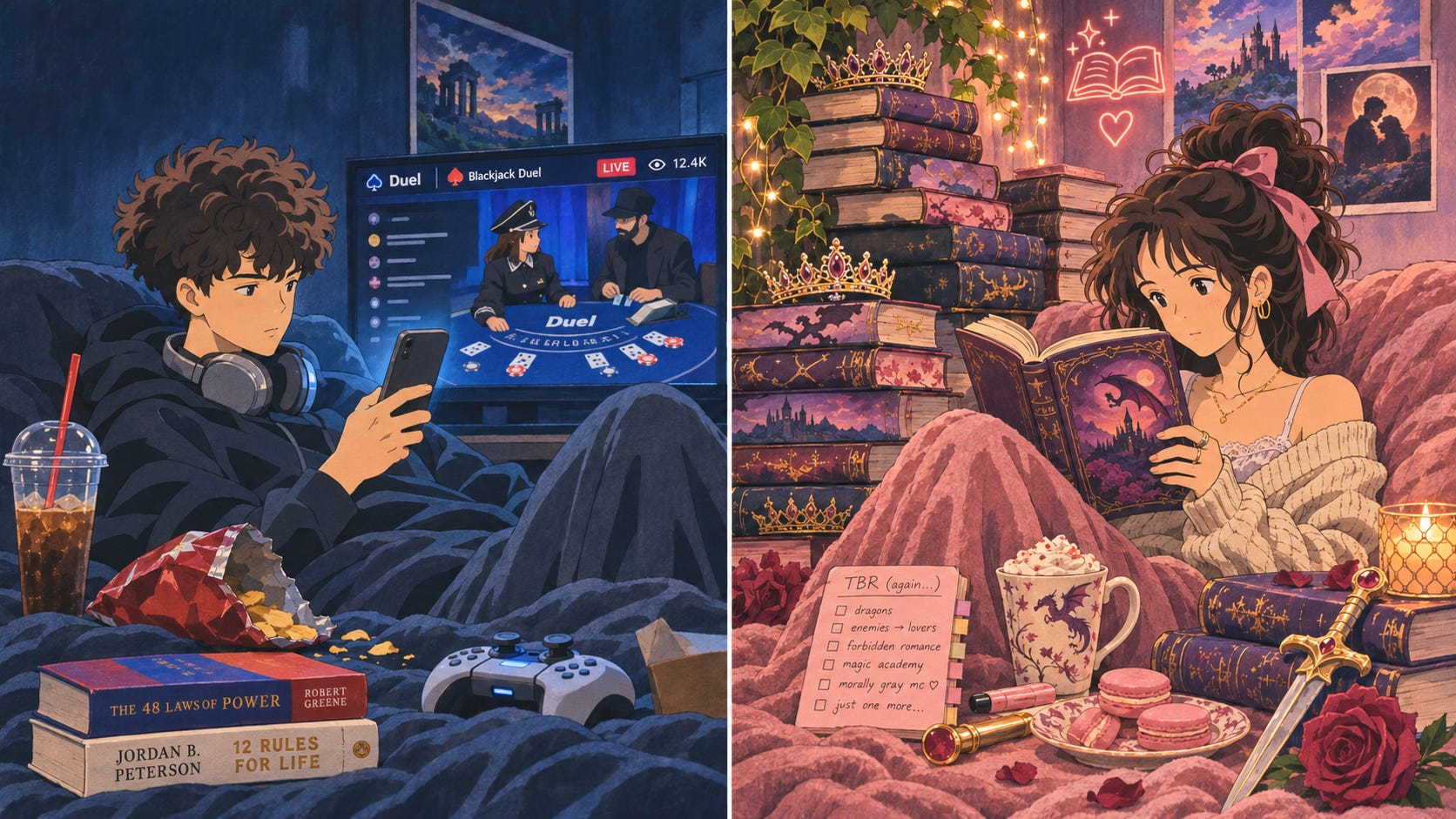
One of the most depressing pieces I can remember reading in recent years is a study on the literacy of American college students, specifically English majors.
Researchers at two universities in Kansas asked 85 English majors to read the opening seven paragraphs of Charles Dickens’s Bleak House, explaining in their own words what each passage meant. They were allowed access to the internet and dictionaries to assist. The results were astonishing.

Some 58% understood so little of the text that the researchers concluded they would be unable to read the novel independently. Another 38% could interpret only about half of its literal meaning. Just four students out of 85 demonstrated a detailed understanding of the passage.
The examples of their attempts at interpretation make for painful reading. One student, encountering Dickens’s description of a lawyer with “great whiskers” on his face, concluded he must be describing a cat. Again, these were students who had chosen to major in English.
These findings seemed incredible, and I recounted them to a couple of people I know who have taught university students. Though both are now pursuing other endeavours outside formal academia, they informed me that reports they received from their former colleagues painted a picture every bit as bleak — “it’s worse than you can possibly imagine.”
An Atlantic article from 2024 titled The Elite College Students Who Can't Read Books gives a similar impression from a larger sample of college professors. Its author interviewed 33 academics, many from elite universities and most expressing similar dismay at the state of their students’ reading abilities. Some professors reported encountering students who had never been tasked with reading an entire book throughout their schooling, while others described halving their reading assignments and replacing works like Crime and Punishment and Moby-Dick with shorter, less demanding texts.
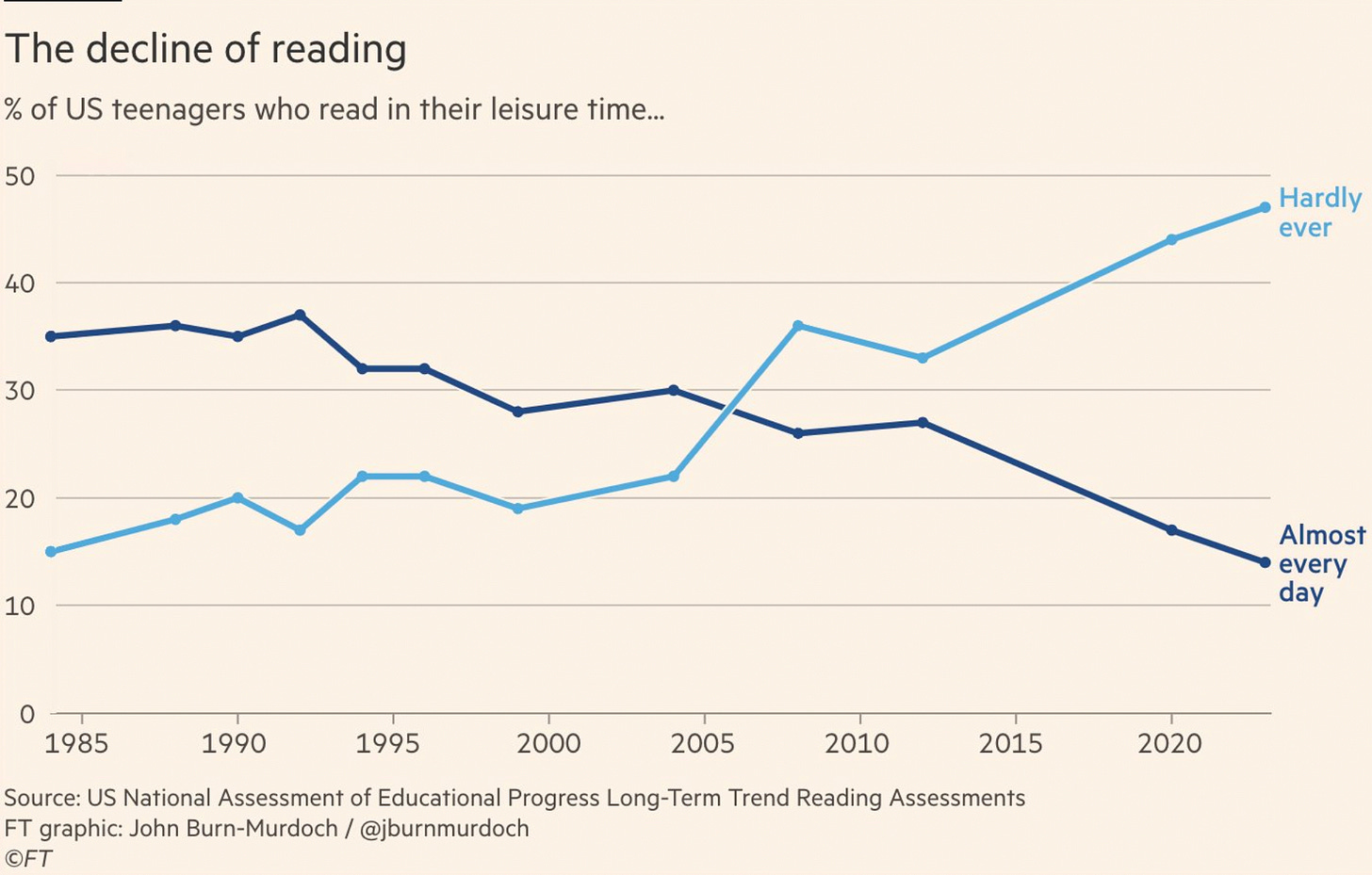
This rot is visible in data on society’s reading habits. In 1976, around 40% of American high-school seniors reported reading at least six books for pleasure in the previous year, while just 11.5% had read none. By 2022, those numbers had practically reversed, and I suspect it has become markedly worse again in the four years since.
The data on total book sales hasn’t actually fallen very much, but the raw numbers mean less when you look at what people are reading. Most books now are read by women, and the biggest areas of growth have been female-driven genres like romance fiction, with its emerging subgenres like romantasy and dark romance popularised by the BookTok trend and marketed heavily towards young women.
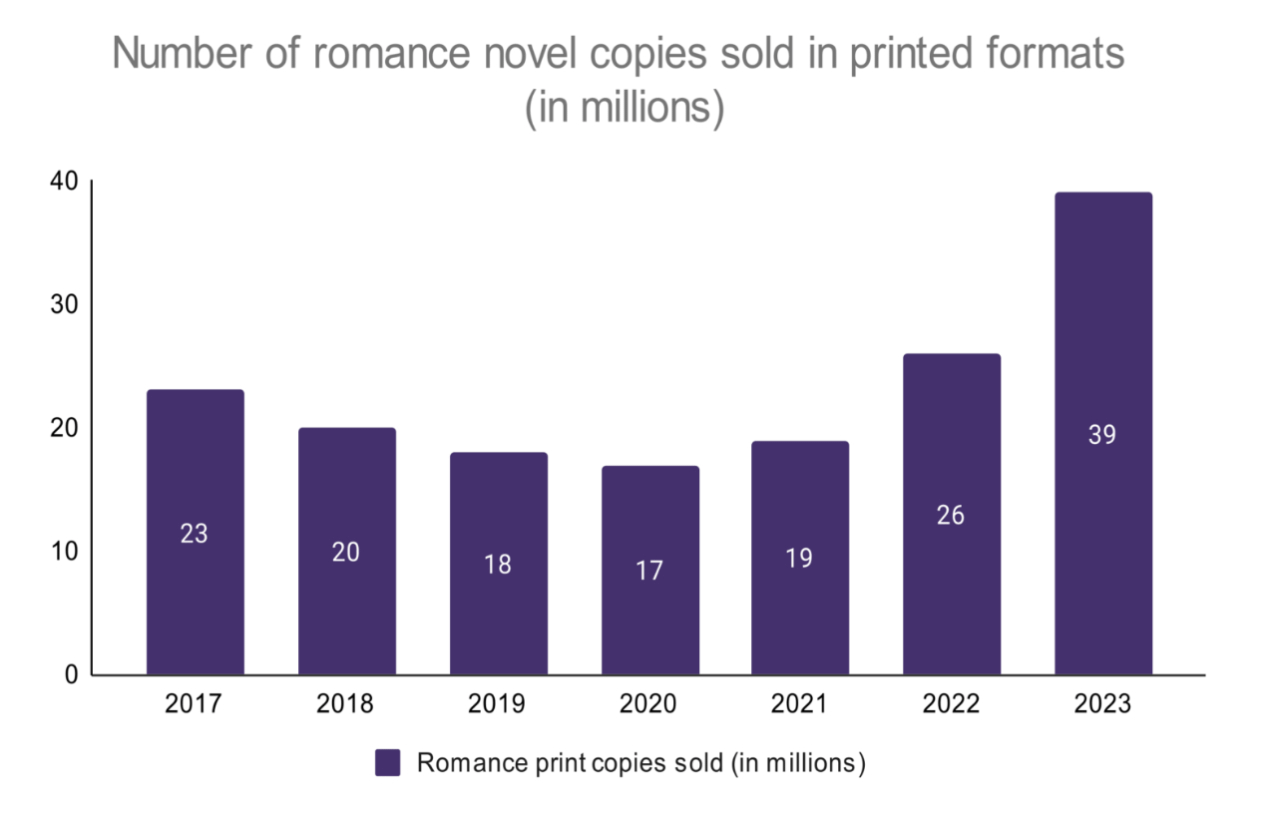
More than a third of all book purchases in the UK last year were made by women aged 13–44, overwhelmingly reading literary slop. As women have become more comfortable with sharing their smut preferences, a very sizeable and growing share of this market is much closer to a socially acceptable form of pornography than literature. This is no more a cause for optimism about “evolving reading habits” than the exploding popularity of online gambling is evidence of a revival in numerical literacy.

It would be comforting to dismiss this as another symptom of the creeping idiocracy of mass society, but I’m afraid it affects my own, politically engaged subculture as much as anything. Since becoming conscious of this trend, my encounters with politically engaged people of my generation and younger (which is to say, almost everyone I meet these days) have been coloured by a dispiriting awareness of this rot that conversation after conversation has only confirmed.
Among Generation Z, my experience has shown that even the most obsessive autists now gather their worldview almost exclusively from livestreams, YouTube and short-form video content, perhaps supplemented by occasional consultation with LLMs. I recently spoke to someone who had a drastic change in ideology after being redpilled by online content, then switched sides between multiple niche online factions in a short period of time. These later swings reflected no ideological conversion of any kind, but meretricious judgements like which influencers they felt possessed more aura, or whose audience had a higher representation of uncool chuds.
Another illuminating example came when I published my review of Richard Spencer and Mark Brahmin’s literary bowel movement. Viewing the responses, I discovered there is an entirely new group of Gen Z followers Richard Spencer has cultivated under the label of “Apolloism” in recent years, followers who are entirely ignorant of what Apolloism actually entails, or anything its founders actually believe about religion, but who nevertheless proudly count themselves among its adherents because they enjoyed a genre of TikTok edits around Richard Spencer’s monologues.
It would be easy to dismiss these as the peculiarities of an especially unserious online subculture built around pretentious midwits, but I suspect they reflect a more general change in the way political convictions are acquired. For an earlier generation of online radicals, the familiar redpill journey typically began with an encounter with taboo ideas, initially resisted, followed by a frantic search through obscure books and datasets to discover whether their unsettling new suspicions were justified. Today, the process seems to have become an almost entirely vibes-based affair, in which ideological conversions have less to do with an encounter with ideas or uncomfortable facts than with the personalities, images and cultural associations surrounding them. The ideas themselves are largely secondary, deployed only in defence of an identity already adopted, or as a kind of peacocking to demonstrate intellectual novelty.

Don’t think I’m being snobbish. I acknowledge that I myself have been embarrassingly neglectful of literary fiction, especially as my screen time has increased — a deficiency I am sometimes painfully conscious of when talking to people whose literary horizons extend far beyond the mountains of philosophy and political theory on which I’ve concentrated my intellectual life. But I have retained some expectation that a movement that professes to defend Western civilisation would aspire to some familiarity with its greatest intellectual traditions. I think this was the case prior to the smartphone revolution, at least among the most influential thought leaders and activists. The radical right was smaller 15 years ago, but it counted among its ranks plenty of men of genuine intellectual distinction and a sizeable reading audience who seriously engaged with their ideas. Of course, part of the explanation for this change is simply that these ideas have become more popular, and a larger audience means less intellectually inclined people finding their way here through other forms of media. But that’s not the only cause.
As we enter a post-literate age, it also strikes me that the superficial novelty of ideas seems to be taking on special significance. People who are ignorant of an intellectual field typically underestimate the depth of mastery required to have any worthwhile contribution to make. Another virtue of reading genuinely profound works is that they demand a certain humbling of the reader, a willingness to recognise the limits of one’s own understanding and submit to the intellectual vision of another mind. There is also something chastening in discovering that a thinker who has been dead for centuries already arrived at one’s own insights, and expressed them with a subtlety and sophistication one can scarcely hope to rival. It is typically only after years of serious engagement with the greatest minds of a particular field that even the most precocious thinkers acquire the intellectual foundations necessary to synthesise existing ideas and make a genuinely original contribution.
But for those whose intellectual horizons extend no further than the fads of online subcultures, the priorities are reversed: ideas become valuable only insofar as they appear novel, esoteric or avant-garde — and in a climate of sufficient ignorance, anything merely obscure and elitist can be mistaken for profound. With little patience for the sustained effort required to grapple with a difficult thinker, such people never allow great works to penetrate deeply enough to really transform their understanding. For the screen-addled Zoomer, ideas are little more than intellectual bling, collected like charms on a bracelet, with little concern for whether they belong together, so long as they glitter brightly enough to be flaunted as evidence of a sophisticated mind.
The internet, smartphones, and a general decline in cultural standards were enough to get us to this point, but they will probably all pale in comparison to the consequences of making generative AI an ever-present companion to intellectual life. Learning anything worthwhile requires some difficult and often tedious work. There is a peculiar satisfaction in the moment when, after struggling for pages with a difficult author, his intellectual vision suddenly comes into focus, illuminating retrospectively passages that had previously seemed impenetrable.
I have a fond memory of such an experience after hours spent grappling with Spinoza’s Ethics, when I was still a novice in philosophy and, after purchasing the book not really knowing what I was getting myself in for, had little to guide me through its intricate succession of definitions, axioms and propositions beyond the internal logic of the work itself. Now, for countless readers, that struggle would feel like a tedious waste of time, when a few prompts from ChatGPT could furnish them with a lucid summary of Spinoza’s entire philosophical system.
But to reach straight for the conclusions is to miss what is greatest about the encounter with a profound thinker: the opportunity to exercise one’s own intellect in following the movement of his thought. This is a moral as well as an intellectual exercise, requiring the reader to set aside his own pretensions and acquire some humility in entering into the mind of another. This is why narcissists never make good philosophers, and why a less literate generation is bound to be more narcissistic.
Post-literacy and politics
I don’t wish this essay to entirely be a rant about cultural decline. What sparked this piece is a reflection on my last essay, where I concluded the right can only progress beyond the dead end of reactionary slopulism by reformulating itself around a new intellectual vanguard, in much the same way the left was wrestled away from trade unionists and traditional social democrats by the university radicals and intellectuals of the New Left.
Many of the greatest obstacles to the metapolitical progress of the right are still intellectual — the equality thesis on race is an orthodoxy among contemporary educated Westerners as much as the dogmas of the Church were in the Middle Ages. The right is at a disadvantage in the “human capital” it attracts largely because it attaches itself to intellectually flimsy justifications for its worldview, and because it fails to challenge progressive orthodoxy except on aesthetic grounds.
But thinking about a way out of this raises uncomfortable questions. Where is such an intellectual vanguard supposed to come from in a generation increasingly incapable of sustained reading and whose political imagination is entirely shaped by bombastic media personalities and algorithmically curated snippets of information?
That’s not to say the left is chock full of cultured intellectuals, but they have a clear advantage over the right. The distinction is not so much between the ordinary voters of the two camps as between their politically engaged members: the left has a substantial intermediate class of journalists, academics, activists and other professionals whose work revolves around the written word, and who absorb, interpret and transmit the ideas developed by its intellectual elites. There is thus a relatively durable pipeline through which new ideological commitments can pass from intellectual circles into practical application by political movements, without the average activist having to read tracts of political philosophy.
On the right, this pipeline is weak. There are few intellectuals being produced or sustained by right-wing institutions or patronage networks, and there is next to no intermediary class to disseminate their ideas into political strategy. Instead, political opinion is shaped largely by direct relationships between online personalities and their audiences. Personalities are supported insofar as they can drive donations and advertising, and consensus is largely set by whatever drives social media engagement. And since anger and outrage are the emotions most readily aroused among those hostile to the existing order, the resulting politics is overwhelmingly reactive, paranoid and lacking in positive content. Small wonder, then, that the right so often struggles to articulate a vision capable of appealing beyond those already convinced of its grievances.
None of this is to say that a political movement needs to be made up of voracious readers and intellectuals to succeed. Few of the workers and soldiers who rallied to the Bolsheviks had read a page of Marx, and France’s revolutionaries didn’t need to know who Rousseau was to resent the privileges of the ancien régime. There are also clear benefits to this more decentralised, personality-driven political culture where outsider radicals can circumvent the gatekeeping networks established by the old boys’ club and broadcast ideas directly to an audience that would otherwise have been suppressed (I did, after all, first gain my following giving my unfiltered thoughts on a YouTube channel.)
But the recent descent of the right’s intellectual output into incoherence, the insatiable appetite for conspiracy theories and medieval superstitions, the abandonment of unfashionable truths that the dissident right safeguarded in favour of bizarre syncretisms and capitulation to leftist ideology — all these testify to the failures of a movement lacking the intellectual scaffolding and habits of mind necessary to preserve a coherent tradition and distinguish serious thought from nonsense.
The abject failures of two Trump terms and of populist experiments across Europe point to a troubling prospect: that a resurgent right can succeed in acquiring power only to squander its opportunities, discredit itself and revitalise the left through a failure of political imagination. With the precious little time we have to reverse the destructive trends of our current course we can ill afford to make the same mistakes again. There are no shortcuts to developing the ideas and institutions necessary to make better use of the next opportunity. In trying to recover a culture of serious intellectual engagement, we may find ourselves swimming against the current of almost every technological and cultural trend of our age.
But if there is one advantage we can never afford to squander, it is our commitment to truth, and the conviction that it is worth pursuing even when it challenges the prevailing conventions of our age.
Thanks for reading. I can no longer accept paid subscriptions on Substack, having lost access to Stripe and most other payment processors after being placed on a financial blacklist in a particularly egregious case of ideological censorship.
If you would like to support my independent work, please consider making a cryptocurrency donation using one of the addresses below, or contact me directly to arrange an alternative donation method.
I often need to remind myself when arguing online with anonymous strangers. I take a step back and wonder: "has this person even ever read a single thing about the topic we are disagreeing about?" I wonder how much time I have wasted this way…
On the right, I would argue it not only affects Zoomers but also the TV-slop boomers. Admittedly, left-leaning liberal boomers do read some non-fiction or at least the newspaper.
Excellent article, and something I’ve been thinking about a lot myself recently as I watch friends of mine undergo wild ideological swings (sometimes into outright leftism) and forget the basics